
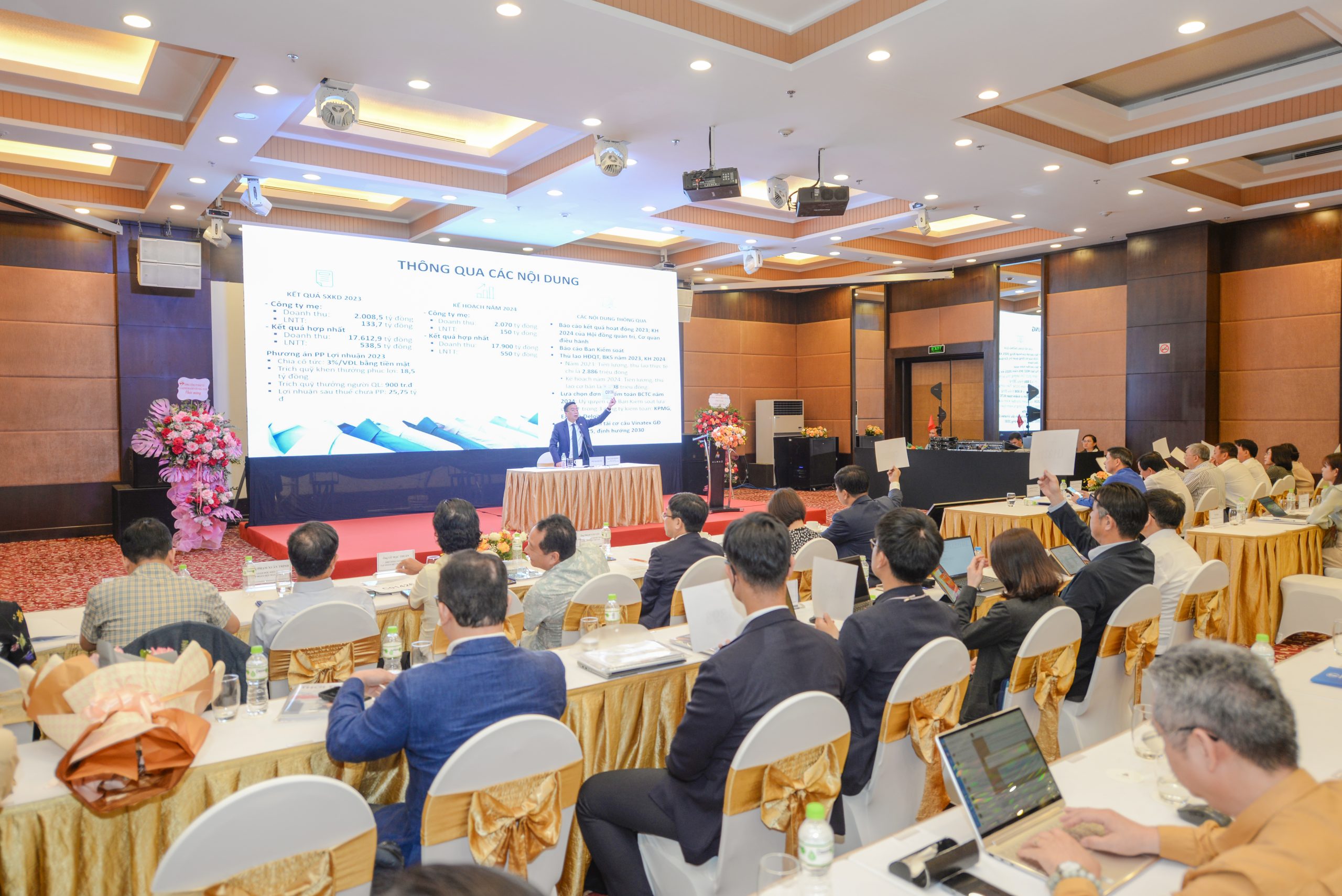
We have basically completed the 2026 general meeting of shareholders across member companies with capital contributions from the Vietnam National Textile and Garment Group, with only a few companies and the Group’s parent company expected to finalize their meetings later this May. Overall, 2025 was a year of highly consistent business performance across all enterprises. For the first time in its 30-year history, every textile and garment manufacturing company with Vinatex capital participation operated profitably. The units facing the greatest challenges — primarily those focused on yarn production — such as Nam Dinh Textile, 8-3 Textile, Hanosimex, and the Group’s two yarn branches, all recorded significant improvements.
In 2025, among the companies with capital contribution from Vinatex, three enterprises recorded consolidated profits exceeding VND 400 billion (Viet Tien Garment Corp, Phong Phu JSC, and Hoa Tho Textile – Garment JSC) — including one affiliated company with profits surpassing VND 500 billion (Viet Tien Garment Corp). Four other companies posted profits/consolidated profits ranging from over VND 100 billion to more than VND 200 billion (Nha Be Garment Corp, Garment 10 Corp, Hue Textile & Garment JSC, and Huu Nghi Garment JSC).
The group of companies achieving after-tax returns on charter capital above 40% now accounts for nearly 30% of the parent company’s investment portfolio. Several well-known enterprises that had consistently ranked among the Group’s leaders for many years but showed signs of slowing down after the Covid-19 pandemic successfully restructured their business models in 2025, regained strong growth momentum, and returned to leading positions within the Group, notably Viet Tien Garment Corp and Phong Phu Corp.
Companies that have continuously maintained high-quality growth over the past four years include Hoa Tho and Hue Textile & Garment JSC, both achieving returns on charter capital of around 100%. This year also witnessed breakthrough efficiency growth at three enterprises: Garment 10 Corp (which for the first time in its history posted profits exceeding VND 200 billion with 50% growth); Viet Thang (which recorded 68% profit growth) and became the only pure textile-yarn manufacturing enterprise with a pre-tax return on charter capital exceeding 25%; and Hung Yen Garment (which achieved profit growth of 28%).
For the first time, 12 companies within Vinatex’s investment portfolio achieved an A-level Z-score (above 3.0), accounting for 50% of all enterprises in the portfolio. 4 companies achieved B-level ratings (indicating stable performance with Z-scores above 1.8). Only 4 companies remained in category C (Z-scores above 1.1), though they recorded strong score improvements compared with 2024 and are approaching the 1.8 threshold required for category B. Meanwhile, 4 category D companies, mainly in the yarn sector, are gradually overcoming the accumulated difficulties from the 2022–2024 period.
Built on the foundation of consistently strong performance across its invested enterprises, particularly major subsidiaries such as Phong Phu, Hoa Tho, and Hue Textile & Garment — the Group achieved a new record in consolidated profit in 2025, reaching VND 1,479.8 billion. Pre-tax return on equity (ROE) rose to 29.7%, coinciding with the 30th anniversary of the Group’s establishment.
Looking back, we have gone through 5 highly challenging years (2021–2025): the Covid-19 pandemic in 2021; the Russia–Ukraine conflict beginning in 2022; the market crisis and the textile and garment sector’s first export decline after 30 years of economic opening in 2023; the yarn industry crisis from June 2022 to July 2024; the reciprocal tariffs in 2025; as well as mounting pressures from buyers regarding price reductions, supply chain traceability, green production, and circular manufacturing, alongside tighter credit conditions imposed by financial institutions.
Against this backdrop, it is obvious that enterprises have become significantly more mature in terms of strategic autonomy, operational flexibility, product and market restructuring, and especially their ability to assess, forecast, and respond proactively to market developments from an early stage and at a distance.
The most striking aspect of the shareholder meetings held so far is that none of the Boards of Directors or Executive management teams treated the external challenges mentioned above as excuses for declining business performance, nor as grounds to overstate management’s “overcoming difficulties” achievements.
Instead, enterprises have approached undesirable, unpredictable, or challenging market developments — as external variables that management teams are responsible for addressing directly, without avoidance. Facing problems and resolving them thoroughly has become the central message conveyed to shareholders.
The second major shift, equally important, is that most shareholder meetings no longer viewed intense competition for labor as an unsolvable challenge. Instead, enterprises have shifted toward treating wages and labor costs as fundamental input costs of the product, accepting market-based compensation levels in each locality.
With income benchmarks set at approximately 1.3 times local GRDP — and strong-performing enterprises reaching over 1.5 times local GRDP — companies have initially succeeded in halting the continuous decline in workforce numbers. In 2025, three out of twenty garment enterprises recorded workforce growth, ending a three-year consecutive decline in labor. At the same time, the rate of workers returning to factories after the Lunar New Year holiday reached as high as 99%.
Looking back on the lessons learned by both the enterprises and the Group over recent years, the core lesson has been the development of a mindset of autonomy. Strategic orientations and guiding ideas from the Group level were rapidly transformed into proactive action at the operational level.
While supporting weaker enterprises to help them improve, a KPI framework measuring levels of self-reliance was established to define each unit’s improvement roadmap. Built around 4 pillars of autonomous capability: market, finance, production, and workforce — the spirit and mindset of self-reliance have become a shared culture across Vinatex, especially among weaker units that still require support, where striving for self-sufficiency is regarded as a matter of honor for management teams and company representatives.
The new concept of self-reliance that is now being developed and shaped does not mean “closing off” — neither accepting help nor supporting others — it reflects a low level of connectivity or a self-sufficiency mindset in the narrow sense of “self-supply and self-subsistence.” Instead, the current culture of self-reliance is about autonomy in competition and collaboration, with enterprises always ready to expand their sphere of influence and competitive capabilities. Self-reliance is no longer merely about fulfilling the annual business plans assigned by shareholders; it is about building toward resilience and strength. It means making both individual enterprise and the entire Group stronger, deeper in capability, and more resilient in the long term.
Through specifically policies and actions aimed at building autonomous and resilient enterprises, together with the initial achievements gained over the past five years of challenges, business leaders across the Group have developed a strong sense of confidence: in the capability of their teams, in the Group’s leadership, in the strength of internal linkages, and in the system’s ability to support one another and overcome difficulties together.
It is precisely these shared characteristics — functioning like a common “DNA” across the organization — that explain why, despite nearly 20 different shareholder meetings being held over the past two weeks, the prevailing theme consistently highlighted has been: “Confidence – Autonomy – Resilience.” This has been reflected in accurate forecasting, detailed yet flexible response plans, and the calmness, steadfastness, and strong determination demonstrated by employees across all units.
Looking ahead to 2026 and beyond, the shareholder meetings shared a common forecast that volatility will remain intense, with markets likely to shift continuously due to tariffs, wars, inflation, and other uncertainties. Only enterprises with strong adaptive capabilities will be able to maintain their positions in the market.
Companies have chosen to contribute to the country’s target of achieving over 10% economic growth by increasing trade surplus, raising value added (VA), and improving workers’ incomes by more than 10%; not by expanding revenue scale or export turnover. Total Factor Productivity (TFP) growth is targeted at over 6% annually.
Enterprises also determine the need to develop new profit centers beyond traditional manufacturing, while still remaining closely integrated within the global textile and apparel value chain. In the past, the industry mainly focused on upgrading business models from CMT to FOB and ODM, or on developing raw materials to increase domestic value creation. Today, however, companies have begun researching and participating in the logistics segment of the global fashion industry. Enterprises are carefully studying development strategies in response to the restructuring of local administrative systems, the operation of the two-tier government model, and especially following the adoption of the 14th National Party Congress Resolution earlier this January, in order to align corporate strategies with national macroeconomic planning and the country’s two centennial development goals.
Vinatex has gone through significant and highly innovative changes over the past five years, with enterprise self-reliance and resilience serving as the central pillar. Complex developments in global markets and international economic relations have become the new normal. Annual business results may rise or fall, but maintaining strong determination and remaining in control of their strategic direction will define the new mindset of enterprises across the Group. Both the Group’s leadership and its enterprises share the belief that with a foundation and culture built on self-reliance and resilience, they will always move forward with confidence into new phases of challenge.
By Dr Le Tien Truong, Secretary of the Party Committee, Chairman of the Board of Vinatex