
On December 22, 2024, the Politburo issued Resolution No. 57-NQ/TW on breakthroughs in science, technology, innovation, and national digital transformation – a document described as the “Khoan 10” of the digital era. It identifies these areas as the “top-priority breakthrough” for the country’s advance in the new era, positioning data as a “primary means of production”, and identifying enterprises as the subjects and driving forces of this process. For the Vietnam National Textile and Garment Group, this spirit is not a slogan but the highest-level affirmation of a path we chose and must now pursue faster and more decisively: the shift from traditional management to data-driven governance.

CONTEXT AND URGENCY
The global textile and garment industry is entering a new cycle of competition where data, technology, and digital connectivity become critical to competitiveness. Smart manufacturing, integrated supply chains, and real-time data-driven operations are reshaping production and trade. Pressure from brands no longer stops at quality and cost: Uniqlo requires factories to fully digitalize for traceability; Nike and Adidas have stated that “securing orders requires a digitized system”; and Inditex is ready to remove suppliers from its chain if their data is not transparent. Meanwhile, direct competitors—from Esquel and Texhong to Shahi Exports and DBL Group – have completed their digitalization and are applying AI across their value chains. The low-cost labor advantage that underpinned our competitiveness for three decades is no longer enough to protect our position in the value chain.
Internally, the need for transformation is even more urgent. Vinatex operates a close-loop value chain – Spinning – Weaving – Dyeing – Garment Manufacturing, with over 30 member companies and nearly 60,000 workers. For a long time, however, management relied mainly on fragmented spreadsheets; data lacked common standards and was not connected across warehousing, production and finance; and nearly half of the member units had no dedicated IT staff. Decision-making therefore depended heavily on individual experience, while markets changed weekly, orders grew smaller, delivery times shortened and margins thinned. Group leaders have repeatedly emphasized: for us, digital transformation is no longer modernization – it is a matter of survival.
VINATEX’S STRATEGIC VISION
Vinatex embarked on this journey early. In January 2021, the Group Party Committee issued Resolution No. 06-NQ/ĐUTĐ on digital transformation for the period 2021-2025 – nearly four years ahead of Resolution No. 57-NQ/TW. Within 9 months, the structure was comprehensively strengthened at both levels: a Digital Transformation Steering Committee chaired by the Board Chairman, a Digital Transformation Project Management Board and an IT & Digital Transformation Department as the dedicated bodies. From the start, we remained committed to principles that practice has proven correct: governance before technology; standardization before digitization, never “digitizing chaos”; business operations leading technology; and a pilot–standardize–scale approach that is gradually replicated across the system.
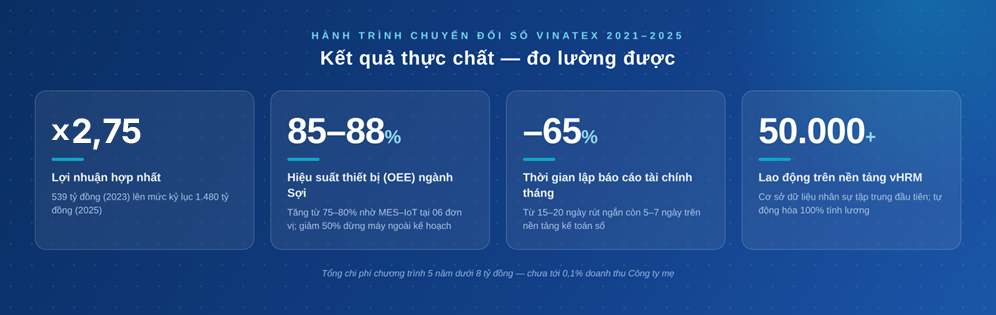
This approach has delivered tangible, measurable results. The Manufacturing Execution System (MES) connecting machinery through IoT has been deployed at six Spinning units, raising overall equipment effectiveness from 75–80% to 85–88%, halving unplanned downtime and enabling real-time production reporting. The vHRM human resource management system, developed by the Group, has created a centralized database for over 50,000 employees and fully automated payroll. Monthly financial reporting has been shortened from 15–20 days to 5–7 days, while digital offices have mainly replaced paper documents. More importantly, the program’s total five-year cost was under VND 8 billion – less than 0.1% of the Parent Company’s annual revenue – while consolidated profit rose from VND 539 billion in 2023 to a record VND 1.48 trillion in 2025, 2.75 times higher, with an approximately 6% increase in overall productivity. Digital transformation, when done correctly, is not where money is spent – it is where value is created.
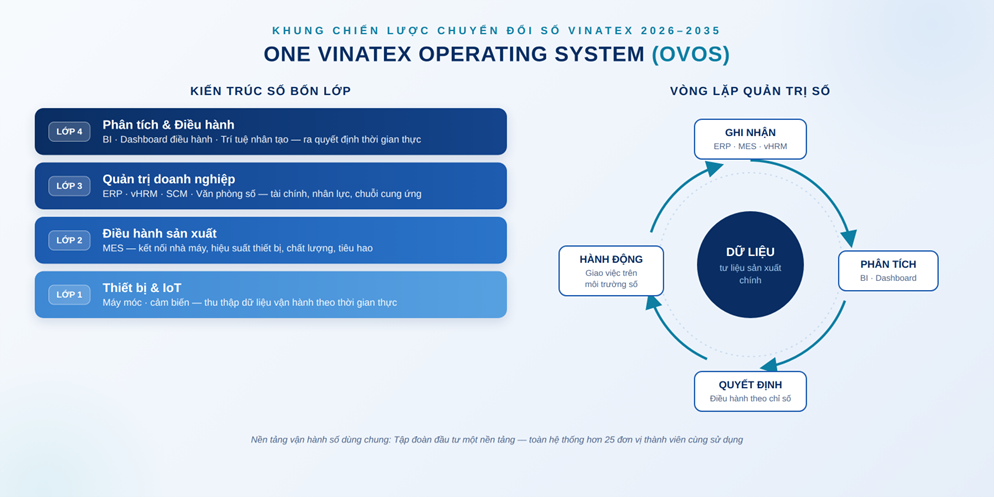
From that foundation, in December 2025, the Group approved the framework for its 2026–2035 Digital Transformation Strategy, centered on the “One Vinatex Operating System” (OVOS) – a shared digital operating platform for the entire system built on a four-layer architecture, covering IoT devices, production operations, enterprise management, data-driven analytics and management, and AI. Our vision for 2030 is clear: the entire Vinatex system will operate on a unified digital management platform, with centralized real-time data, digitalization exceeding 60%, and operations fully driven by data and standardized indicators – laying the foundation for AI across the value chain by 2035. This is “Digital Vinatex” – a microcosm version of the “Digital Vietnam” envisioned by Resolution No. 57-NQ/TW.
THREE PILLARS FOR THE SHIFT FROM TRADITIONAL MANAGEMENT TO DATA-DRIVEN GOVERNANCE
Pillar 1: Data standardization and digitalization. You cannot govern by data until data itself becomes a governed asset. The Group is reviewing and standardizing all data concepts and definitions, developing a unified “Data Terminology and Definitions Handbook”; and implementing a centralized Data Center for 2026–2030. When all member units speak the same data language, consolidated data across the system becomes reliable and available in real time.
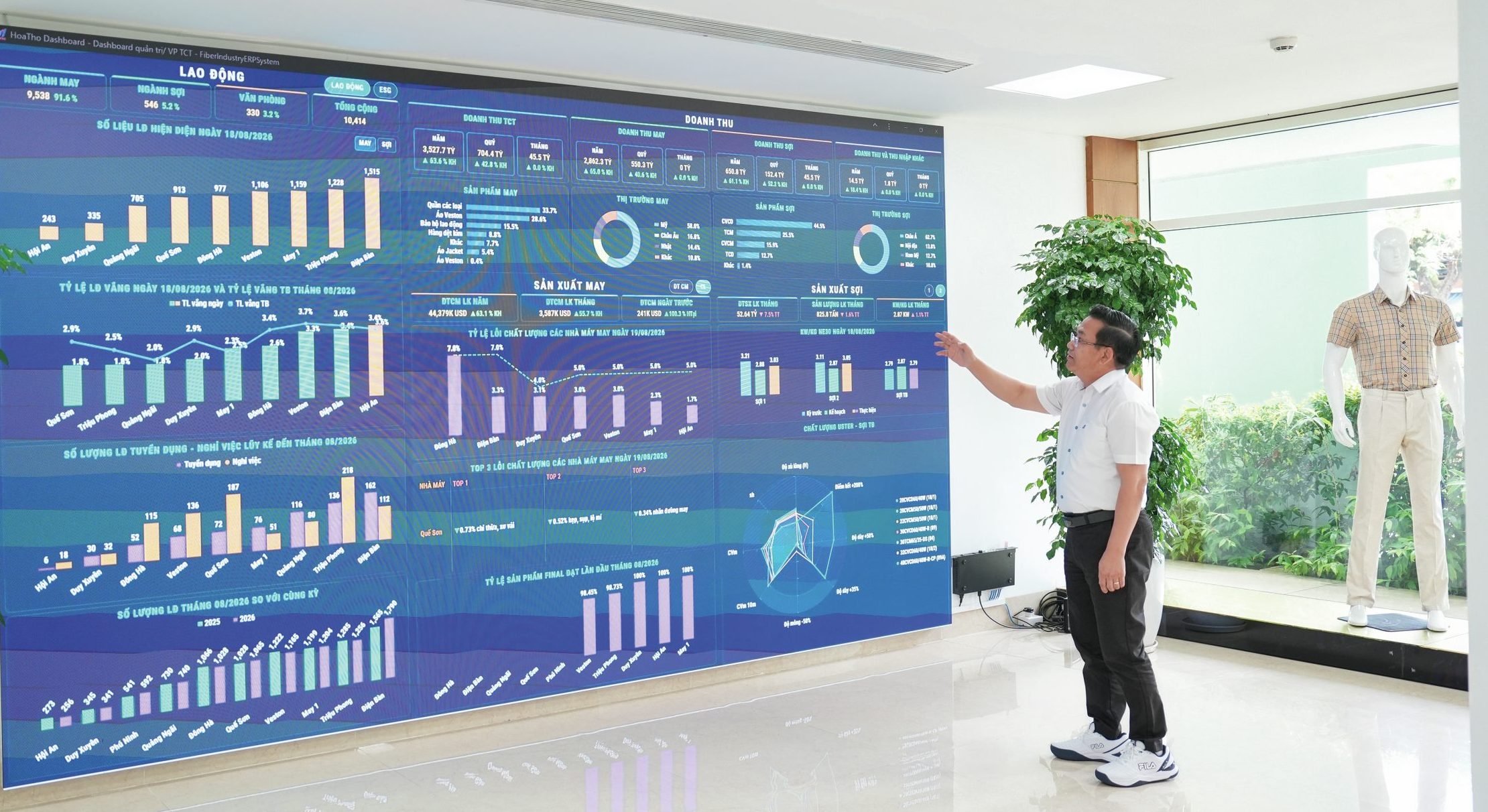
Pillar 2: Data analytics for decision-making. The core of digital governance is a closed loop: business systems record transactions – the analytics platform turns them into indicators – leaders make decisions and assign tasks digitally – implementation results are recorded back into the system. This replaces the lengthy cycle of “paper reports – meetings – directives – waiting for the next report” with a daily and hourly management rhythm. Today, Group leaders can monitor production output, efficiency, inventory and cash flow across member companies through a consolidated dashboard – unthinkable just a few years ago.
Pillar 3: Value-chain optimization and enhanced customer experience. Vinatex’s strength lies in its integrated Spinning – Weaving – Dyeing – Garment Manufacturing value chain. This strength can be fully unlocked only when the entire chain operates on a common data platform: allocating orders based on each factory’s actual capacity, optimizing system-wide inventory, and automatically providing traceability and sustainability reports to customers. For international brands, a supplier’s digital capability has become a condition for cooperation; for Vinatex, it is also a path toward higher-value stages of the global supply chain.

KEY SOLUTIONS FOR A BREAKTHROUGH
In terms of infrastructure and technology, the Group will complete its four-layer digital architecture by upgrading the financial and accounting core into a unified Core ERP, expanding MES from Spinning to Garment Manufacturing, and developing hybrid Cloud infrastructure and a Data Center with no single point of failure. The group will outsource common software while developing industry-specific solutions in-house, such as vHRM and the Spinning production management system, under a shared-services model to maintain control of technology and data.
In terms of human resources and data culture, people remain the decisive factor. The Group is preparing a shared Digital Services Center with expertise in data governance, business analysis and AI engineering, while applying the Product Owner model to empower those with the deepest business knowledge to define requirements. More importantly, we are building a data culture across the system: every meeting starts with data, every proposal is supported by data, and everyone – from production team leaders to executive directors – is trained to read, understand and act on data.
In terms of institutional mechanisms and information security, the Group applies decentralization and delegation: capable member companies may implement solutions within the common architecture under Group approval and supervision, while the Group will directly lead and implement solutions for units with limited capabilities. This helps address fragmentation. Information security is also a prerequisite for digital trust, with multi-layer protection, data backup and recovery, and continuous monitoring to ensure a secure and sustainable digital platform.

THE ROAD AHEAD
Resolution No. 57-NQ/TW has given state-owned enterprises both a historic mission and opportunity. The Board of Directors and the Group’s Executive Management affirm their highest determination: digital transformation is a program led by top management, under their direct guidance, measured by concrete results and given adequate resources – so that Vinatex will not merely keep pace but lead Vietnam’s textile and garment sector in digital-based governance. We aim to match the level of textile and garment enterprises in China and India.
The Group has determined that the shift to data-driven governance is essential for survival and sustainable development – leaving no room for bystanders. ERP or AI does not directly produce a meter of fabric or a garment, but it creates a faster, more cost-efficient and sustainable enterprise, thereby helping preserve jobs and raise incomes for tens of thousands of workers.
However, if digital transformation only makes management more accurate, streamlined, and efficient, that may not be enough. In the new phase, digital transformation must serve as the infrastructure for INNOVATION. Data and the ability to connect dispersed resources across member companies must create a foundation for breakthroughs – whether in new materials, designs, or production technologies – to create intangible assets and intellectual property for Vinatex in the digital environment. Creating a digital foundation for innovation is the long-term goal and the basis for sustainable competitiveness in a global textile and garment market that is becoming more fiercely competitive, greener, faster, and characterized by lower demand. These conditions are incompatible with the position of an upper-middle-income country unless enterprises take breakthrough steps to move beyond the manufacturing role they have occupied for the past 30 years.
Therefore, every Vinatex member, regardless of position, should proactively change their mindset, learn, and master digital tools in their daily work. Thirty years ago, previous generations built Vinatex – the pillar of Vietnam’s textile and garment industry – with their hands and determination. Today, it’s our responsibility to continue that story with knowledge and data. From Resolution No. 57-NQ/TW to “Digital Vinatex” is the path of self-reliance for a national group in an era of national advancement – a path we have already set out on, and one we will surely complete.