
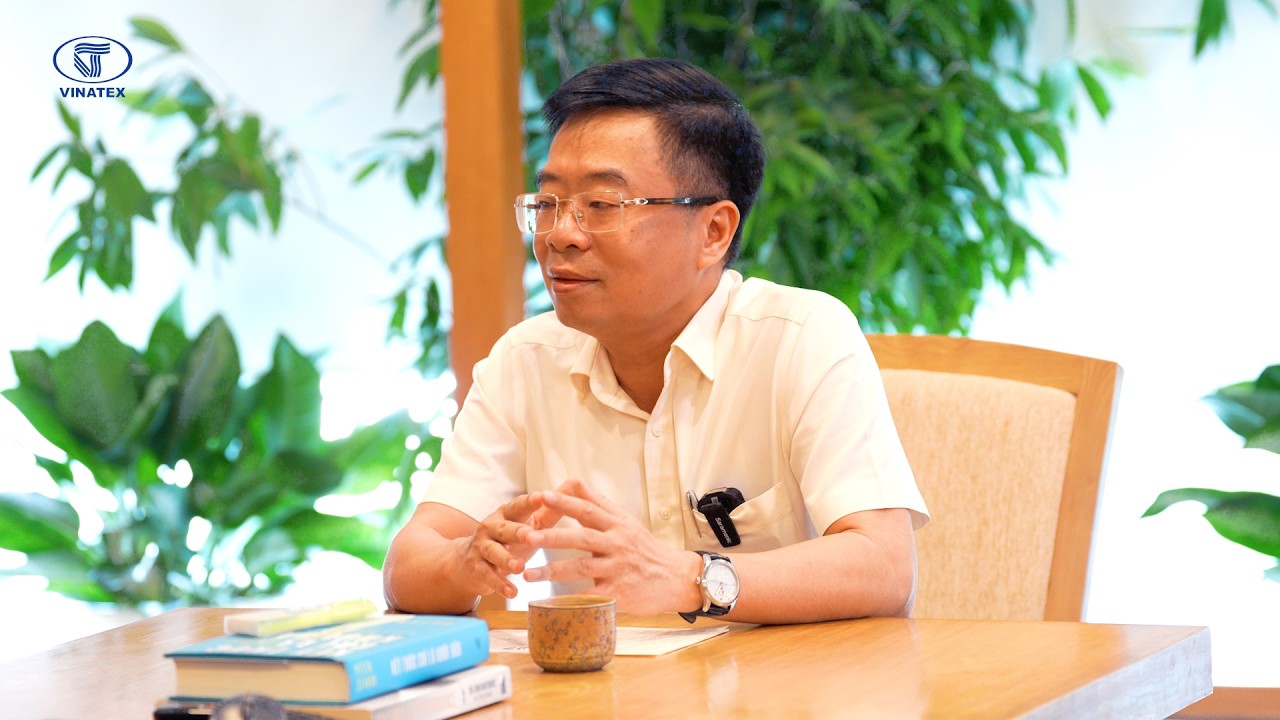
As the global textile and garment market undergoes increasingly severe disruptions, alongside mounting pressure from the green transformation, ESG requirements, and digital transformation, building and embedding Corporate Culture is no longer simply a matter of campaigns, communications, or slogans. At the Vietnam National Textile and Garment Group (Vinatex), Corporate Culture is positioned as a management lever, integrated with business strategy and quantified through a KPI system, making a direct contribution to production and business performance. On the occasion of Vietnamese Culture Day (November 24), Vietnam Textile and Fashion Magazine spoke with Dr. Le Tien Truong, Chairman of Vinatex, about the Group’s approach to building and implementing Corporate Culture across its entire system.
Quantifying the Cultural Pillars
As Vinatex pursues its strategic vision of becoming “A One-Stop Destination for Comprehensive Green Fashion Solutions,” what are the key approaches to integrating the distinctive, long-established cultures of individual member enterprises with a shared, universal corporate culture across the Group?
Dr. Le Tien Truong: Member enterprises within Vinatex all have long histories of development and their own distinctive cultural identities. However, over the past five years, amid major market disruptions, greater strategic alignment and centralized management have become important characteristics underpinning Vinatex’s ability to build collective competitiveness across the Group. In the past, individual enterprises operated with relatively independent business plans, strategies, and operating models, contributing to the Group’s overall results primarily through their business performance and dividends. Today, however, competing independently and in isolation makes it increasingly difficult for enterprises to withstand major market shocks.
In recent years, alongside digital transformation as a core tool and a new management approach focused on managing change, member enterprises have worked with the Group to shape shared cultural values that reinforce centralized management. Only when a common strategy and coordinated management approach are in place does the Group have the necessary conditions to establish a shared corporate culture across the entire system.
Take the “culture of sharing” at Vinatex as an example. Much of the progress made over the past three years has been driven by objective factors, particularly market volatility and geopolitical and geo-economic developments, which have compelled enterprises across the system to work more closely together and seek new management initiatives. As a result, many of Vinatex’s cultural values have emerged naturally from these new operating mechanisms.
While the cultural identity is shared across the Group, the specific standards and criteria adopted by each enterprise vary according to its business characteristics and product segment (spinning, weaving, and garment manufacturing). With the current foundation of transparent digital transformation in place, the 2027–2030 period will mark a new phase in building Corporate Culture, with cultural values being quantified and directly linked to production and business performance under the active leadership of member enterprises.
According to UNESCO’s definition, culture is a set of distinctive spiritual, material, intellectual, and emotional characteristics of a society or social group. However, culture and management regulations have an organic, two-way relationship. Culture shapes habits, while operating regulations serve as control mechanisms to translate those cultural values into practice and ensure that established good habits are consistently followed. Therefore, Corporate Culture cannot be limited to communications and awareness-raising campaigns; it must represent a harmonious combination of business strategy, solutions to practical challenges, and transparent management tools.
As the textile and garment industry faces mounting pressure from the transition toward a circular economy and ESG (Environmental, Social, and Governance) responsibilities, how will Vinatex quantify its six core cultural pillars (understanding the job, mastering the job, loving the job, taking pride in collective achievements, avoiding blame, and continuous improvement) to translate them into tangible corporate competitiveness?
Dr. Le Tien Truong: Current realities show that traditional approaches to long-term strategic planning, are no longer delivering good effectiveness. Instead, enterprises need the capability to identify and resolve challenges quickly in order to identify turning points and respond to changing input conditions. Vinatex’s management strategy is also shifting in this direction, supported by a standardized digital data system across the Group, replacing the more than 30 fragmented “management languages” across member enterprises. This provides the fundamental foundation for developing all of the Group’s core cultural pillars. Although implementation takes place at the grassroots level, the approach can be aligned consistently across the entire system.
For example, in the past, individual enterprises may have interpreted concepts such as understanding one’s profession, mastering one’s craft, taking pride in one’s work, sharing collective responsibility, avoiding blame, and promoting innovation differently. Today, with transparent KPI systems, innovation and shared accountability linked to specific KPIs, enterprise managers can foster corporate culture more naturally and proactively. Through this process, Corporate Culture initiatives have evolved from slogans into practical management tools.
The cultural pillars are now measured against clearly defined criteria: understanding and mastering the job are quantified through specific employee productivity and quality indicators rather than subjective assessments. Loving one’s job is reflected in employee engagement and a proactive commitment to finding innovative solutions in daily work. Similarly, the value of “taking pride in collective achievements,” which was previously rather vague. With KPIs assigned to designated owners (KPI Owners, Key risk indicators KRIs and Risk Owners) – those responsible for managing and controlling KPI can take pride in the results they deliver. The culture of “innovation and continuous improvement” is now measurable through KPI-based incentive and remuneration systems that recognize and encourage creativity, with initiatives being formally assigned, supported, evaluated, reviewed, and ultimately put into practice.
The Group has also taken steps to renew the activities of its Scientific and Training Council, which now evaluates initiatives, research programs, training programs, and the selection of instructors. Structured training is an important institutional mechanism for developing a workforce that progresses from understanding its profession to mastering its skills, thereby creating the foundation for innovation.
All these aspects come along with digitalization, establishing a clear and measurable pathway for every employee group and translating cultural values into corporate competitiveness.
Corporate Culture Must Be Built Early, Ahead of Market Pressures
As a labor-intensive industry characterized by frequent workforce turnover, how does Vinatex effectively implement foundational values such as “loyalty” and “contribution” to retain employees and build trust throughout the organization, from top managers to workers?
Dr. Le Tien Truong: Employee loyalty and commitment to an enterprise must first be built on the cultural foundation of that enterprise itself. A company with strong production and business performance that adequately cares for its employees provides the necessary conditions for building workforce loyalty. We cannot expect employees to remain loyal without first establishing an employee-centered foundation. This is why building Corporate Culture alongside management innovation helps strengthen corporate competitiveness while also enabling enterprises to better address employees’ cultural, material, and spiritual well-being.
In recent years, the Group’s revenue and profit growth targets have consistently been set below its targets for increasing employee wages. This means that Vinatex does not demand employees’ loyalty in advance. Instead, employers accept the responsibility of creating the necessary conditions for employees to demonstrate their commitment, thereby fostering loyalty and long-term engagement.
In an open labor market, job mobility is inevitable. However, Vinatex does not place the emphasis on “long-term loyalty” measured simply by length of service. Rather, we expect employees to demonstrate their loyalty by fully contributing their capabilities to the enterprise during the time they work there.
Vinatex aims to foster a culture in which employees give their best every day they work for the Group. This is a different understanding of “loyalty” from one measured by whether someone has stayed with a company for three, five, or ten years. Furthermore, loyalty should also be assessed through employees’ focus, determination, and active practice of other cultural values, such as mentoring, sharing knowledge, and training colleagues.
In theory, most enterprises would prefer young employees to stay and contribute for at least ten years in order to achieve optimal productivity and quality. However, ten or fifteen years of service is less important than the level of commitment and determination demonstrated during the period an employee works with the enterprise. With a high level of commitment, one year of work can be worth three or even five years of work by someone who is less dedicated. We do not view labor mobility as a negative aspect of the market economy. Instead, wholehearted commitment is the cultural value that enables employees to contribute to building the enterprise.
Vinatex’s production and business results show that although its workforce has gradually declined in size over the years, the Group’s revenue and profit have increased significantly. For example, in 2021–2022, the Group’s consolidated reports recorded a workforce of 65,000 employees across the system, generating VND 19 trillion in revenue and average annual profit of more than VND 1 trillion. Today, with a leaner consolidated workforce of approximately 54,000 employees, the Group generates VND 21 trillion in revenue and approximately VND 2 trillion in profit.
How do you view digital culture in the context of the digital transformation and the ongoing shift at Vinatex from traditional management to data-driven management?
Dr. Le Tien Truong: The transition from paper-based administration to digital management creates urgent requirements for information security and respect for personal data. Without carefully understanding the digital environment and how it works, we can easily encounter data inaccuracies, security breaches, or unintentionally disclose other people’s personal information in cyberspace.
Moving toward data-driven management requires us to fully understand the characteristics, objectives, challenges, and ultimate goals of this new environment. For this reason, we are working to establish new cultural values for management in the digital environment—areas that were not previously addressed in our Corporate Culture framework.
We will pursue two approaches: (1) incorporating new cultural dimensions required by the digital environment, such as information security and respect for personal data; and (2) further specifying existing cultural values to encompass the additional requirements of digital management culture.
As artificial intelligence (AI) and digital management become more clearly defined in the future, we will determine which additional cultural dimensions are appropriate. This demonstrates the process of “innovation and continuous improvement,” one of the core pillars of Corporate Culture that Vinatex is implementing to adapt to the demands of emerging trends.
Inspired by President Ho Chi Minh’s teaching that “Culture lights the way for the nation,” how do you envision the next generation of leaders and Vinatex employees igniting the “light of creativity” to guide the Group through unprecedented volatility and challenges in the digital era and amid global integration?
Dr. Le Tien Truong: At this stage, as cooperation among enterprises becomes increasingly effective, we can begin to address, at least in part, whether Corporate Culture has the necessary conditions to “light the way” for business development. In practice, without an organic connection between business objectives, the development of competitive capabilities, and cultural values, Corporate Culture cannot guide production and business operations. Once this organic relationship is established, culture becomes the starting point for successfully organizing and implementing strategic objectives.
We cannot consider an enterprise to have a strong corporate culture simply because its values are widely promoted while its production and business performance and the material and spiritual well-being of its employees remain average or poor. Corporate Culture must serve the goal of sustainable enterprise development and create more equitable opportunities for all members of the organization to share in its achievements.
Building culture is a continuous process that never stops and can never be declared “complete,” because the workforce is constantly changing, while the business environment and the broader economy are continually evolving. Culture is a “DYNAMIC” factor. If it is neglected, the guiding principles that direct an enterprise’s development can be undermined almost immediately.
In an increasingly uncertain future characterized by smaller orders and tighter delivery schedules, new cultural values must emerge: rapid responsiveness, high productivity, and flexible working practices. Traditional standards such as “punctuality and attendance” may no longer be appropriate in every situation. The new culture may require employees to be ready to work remotely or across different time zones to serve international customers.
Managers must continuously drive innovation in the very process of building Corporate Culture rather than treating it as a rigid concept. Cultural development inevitably takes time. Therefore, to meet emerging requirements, enterprises must prepare early and stay one step ahead of market pressures, enabling them to achieve sustainable development.
Thank you very much, Chairman!