
Transforming the approach from capital management to capital governance, and from monitoring performance to creating value, has been the key to Vietnam National Textile and Garment Group (Vinatex)’s management of its capital representatives at member enterprises. More importantly, the continuous improvements in both management thinking and governance practices have fostered stronger and more effective collaboration between the Group and its member companies. At the same time, they have helped cultivate a culture of unity and collaboration throughout the Group, including affiliated enterprises, thereby contributing to Vinatex’s business performance over the years.
Following its equitization, one of the greatest challenges facing Vietnam National Textile and Garment Group (Vinatex) was not only restructuring its corporate model but also establishing a governance framework suited to its role as a controlling shareholder. As managerial authority shifted away from the previous administrative model, a fundamental question emerged: how could State capital be managed more effectively to generate sustainable value while preserving the operational autonomy of member enterprises?
Against this backdrop, Vinatex’s capital representatives at member enterprises became the vital link between the Group’s strategic direction and governance at its member companies. However, to enable these representatives to fulfill their responsibilities effectively, Vinatex needed an evaluation framework that was scientific, transparent, and adaptable to each stage of the Group’s development. Looking back over the past 15 years (2009–2025), the evolution of Vinatex’s evaluation system for capital representatives clearly reflects the Group’s transformation in governance philosophy. While the initial phase focused primarily on financial oversight and capital preservation, today, the evaluation framework has evolved into a strategic management tool that guides enterprises toward higher operational efficiency, innovation, and sustainable development. This transformation marks Vinatex’s shift from capital management to capital governance, and from monitoring performance to creating long-term value.
The 2009–2014 period: Building the Foundation for Modern Capital Governance
The year 2009 marked the beginning of Vinatex’s capital representative evaluation system. Following equitization, Vinatex’s member enterprises transitioned to a new corporate governance model, operating under the Law on Enterprises, their corporate charters, and the resolutions of their General Meetings of Shareholders and Boards of Directors. The Parent Company’s role shifted from direct operational management to exercising its rights as a controlling shareholder through Vinatex’s capital representatives at member enterprises.
Against this backdrop, an urgent priority was to establish a standardized evaluation framework that clearly defined responsibilities, authority, performance expectations, and matters requiring consultation for capital representatives. This marked the foundation of Vinatex’s capital governance system. The evaluation framework was designed with a strong emphasis on compliance, governance discipline, and accountability for preserving State capital. Assessment criteria focused primarily on year-end financial performance, including profit, dividend payout ratio, and the timeliness of dividend remittances to the Parent Company.
It can be said that this management mindset was well suited to the requirements of the early post-equitization period. At a time when corporate governance practices across the Group were not yet fully standardized, using financial indicators as the primary yardstick enabled the Parent Company to quickly monitor capital efficiency while establishing a consistent management framework throughout the system.
However, as the business continued to grow and market conditions became increasingly volatile, an evaluation system based solely on financial performance began to reveal certain limitations. Many of the factors that drive long-term competitiveness, such as technological innovation, market development, human capital quality, and adaptive capability were not adequately captured by the KPI framework. This realization laid the foundation for the next stage of the Group’s management transformation.

The 2015–2020 period: From Performance Evaluation to Development Capability Assessment
While the initial phase focused primarily on “how much profit was generated,” the 2015–2020 period posed a broader question: was that profit sustainable?
During this period, the evaluation system for capital representatives was expanded in both scope and depth, reflecting Vinatex’s new management philosophy that long-term corporate growth can only be achieved by simultaneously strengthening market competitiveness, technological capability, and human capital. Accordingly, in addition to the traditional financial indicators, Vinatex introduced a wide range of new evaluation criteria covering customer development, market expansion, product development, succession planning, workforce training, employee income, technological innovation, and modernization investment. Capital representatives were no longer assessed solely on year-end financial results, but also on their ability to build the foundations for the enterprise’s sustainable growth and long-term development.
This shift in evaluation philosophy took place alongside Vinatex’s comprehensive restructuring process. During this period, the Group significantly streamlined its corporate portfolio, reducing the number of entities subject to capital representative evaluation from 92 in 2015 to 67 in 2020 (including first-tier subsidiaries, second-tier subsidiaries, and affiliated companies). This was not merely a numerical reduction but a strategic restructuring of the Group’s investment portfolio, aimed at concentrating resources on more competitive enterprises, improving capital efficiency, and simplifying the overall governance structure.
Alongside the restructuring of the Group, its production model also underwent a major transformation. Rather than relying predominantly on the Cut–Make–Trim (CMT) model, its member enterprises progressively shifted toward Free on Board (FOB) and Original Design Manufacturing (ODM), enabling them to capture better value within the global supply chain. A localization rate of approximately 52% provided an important foundation for enhancing the Group’s overall competitiveness amid deeper international economic integration. This period also marked Vinatex’s proactive embrace of the Fourth Industrial Revolution (Industry 4.0). Numerous strategic investment projects were undertaken to modernize production facilities through advanced equipment, automation, digitalized management systems, IoT-enabled manufacturing, and the development of new materials. At the same time, the Group advanced its green transformation strategy by developing LEED-certified factories, investing in renewable energy, improving resource efficiency, and reducing greenhouse gas emissions.
Notably, this period also demonstrated the resilience of the Group’s corporate system in the face of major global disruptions, ranging from the U.S. – China trade tensions to the shock of the COVID-19 pandemic. Against this backdrop, the decision to expand the evaluation framework beyond financial performance to include human capital, technological capability, and managerial competence proved to be well founded. These capabilities enabled enterprises to maintain operational stability even when financial performance was severely affected by external shocks such as the pandemic and global supply chain disruptions.

The 2021–2025 period: Data-driven management – Evaluating for continuous improvement
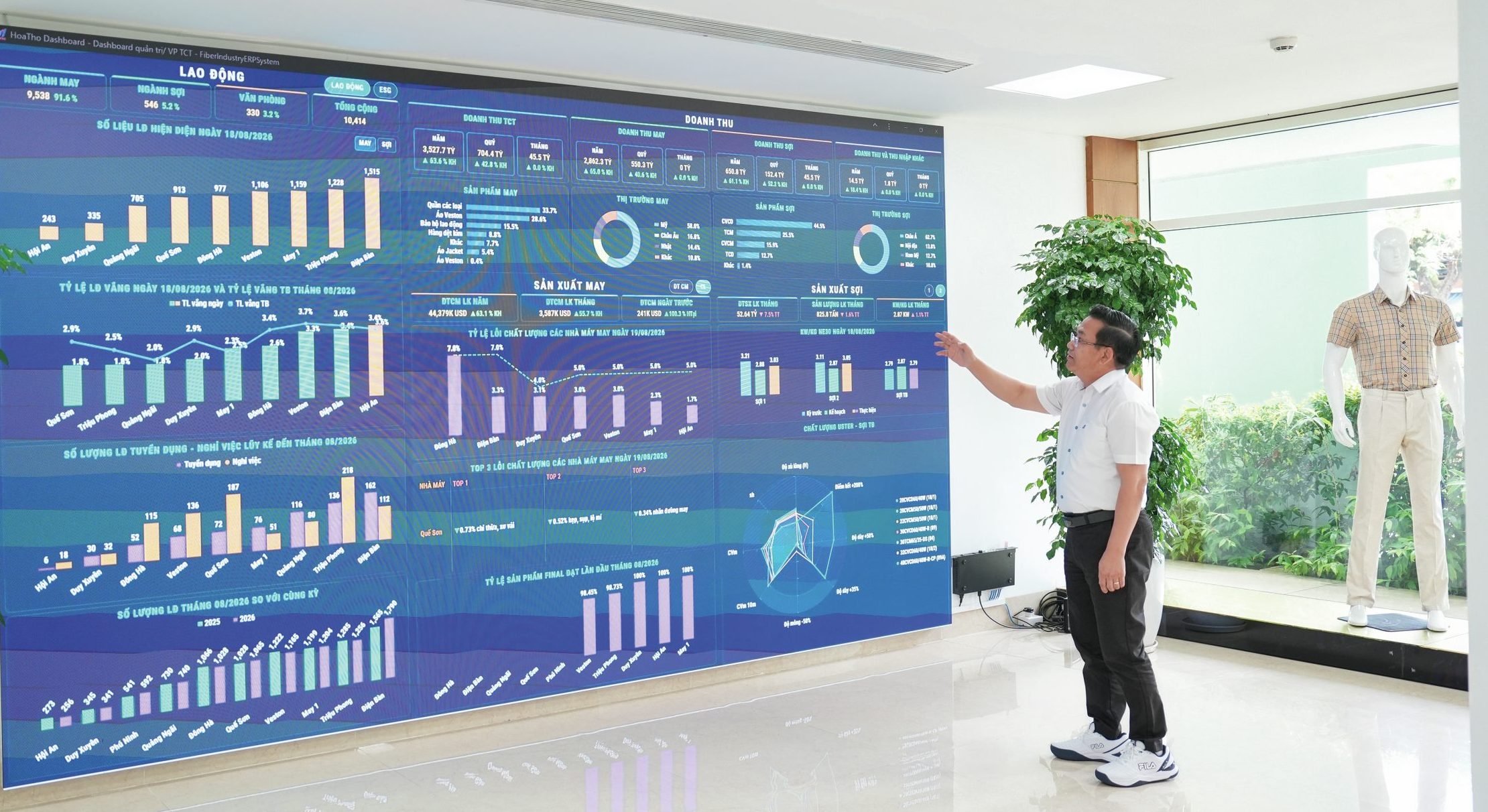
While the 2015–2020 period broadened the scope of evaluation, from 2021 onward Vinatex entered a new stage of development characterized by data-driven management. The philosophy underlying the KPIs system evolved beyond merely classifying enterprises or assessing capital representatives. Instead, it focused on identifying root causes, uncovering operational bottlenecks, and generating actionable insights to improve business performance.
The KPIs system was enhanced with a range of modern management metrics, including Z-score for assessing financial health; Return on Equity (ROE); Return on Assets (ROA); revenue and profit per employee; employee turnover rate; Total Factor Productivity (TFP); and the Cash Conversion Cycle (CCC). These indicators enabled enterprises to be evaluated from multiple perspectives, rather than solely on the basis of year-end financial results.
One of the most notable developments during this period was the adoption of the Z-score as a key indicator of corporate financial stability. By 2025, the Parent Company recorded a Z-score of 3.07, well above the distress threshold and firmly within the high financial safety zone. This demonstrates that the Parent Company’s financial strength had been significantly reinforced following years of comprehensive restructuring.
The effectiveness of the Group’s management practices was also reflected in improvements in labor productivity. Net revenue per employee increased from VND 244.1 million in 2021 to VND 341.4 million in 2025, representing an increase of nearly 40%. This improvement was driven by sustained investments in technology, production optimization, and human capital development, rather than by expanding the workforce. At the same time, employee welfare improved substantially. Average monthly income reached VND 12.14 million per employee in 2025, approximately 30% higher than the average for Vietnam’s manufacturing and processing sector. These achievements reflect the Group’s long-standing management philosophy of placing people at the center of sustainable development.
The 2025 financial results further demonstrated the effectiveness of Vinatex’s new management model. Consolidated profit reached VND 1,480 billion, surpassing the previous peak recorded in 2021 and setting a new all-time high in the Group’s history. More importantly, this achievement was built upon a foundation of strong financial health, high labor productivity, and an increasingly sophisticated data-driven management system.
In this context, capital representatives have evolved beyond their traditional role of exercising shareholders’ rights. They now serve as modern managers, working alongside the Group to advance digital transformation, green transition, and the enhancement of long-term competitive capabilities.

Towards 2030: From Evaluation to Value Creation
The experience of the past 15 years demonstrates that the evaluation system for capital representatives has continuously evolved in parallel with the Group’s management practices. Each stage has reflected a distinct advancement in management thinking, from financial control and capability development to data-driven management. Looking ahead to the 2026–2030 period, Vinatex aims to progress to “Level 4 – Value Creation,” where the evaluation system will no longer serve merely as a tool for inspection or performance classification. Instead, it will become an intelligent management instrument, capable of identifying emerging issues at an early stage, anticipating risks, and supporting strategic decision-making. The central initiative of this phase is the development of a Capital Governance Platform, integrating multidimensional data from finance, production, markets, human resources, innovation, ESG, and digital transformation. With all relevant data consolidated into a unified platform, the evaluation of capital representatives will evolve from measuring past performance to forecasting future trends; from periodic assessments to real-time monitoring; and from evaluating performance to creating sustainable value.
As the textile and garment industry enters a new era of competition driven by productivity, technological innovation, green development, and adaptability to global disruptions, capital representatives will play an increasingly important role as “strategic ambassadors” of the Parent Company within each enterprise.
Looking back over the past 15 years, this has been far more than a journey of refining an evaluation framework. It has been a journey of transforming Vinatex’s management philosophy – from administration to governance, from oversight to partnership, and from capital preservation to value creation. This transformation has laid a solid foundation for Vinatex to consolidate its position as Vietnam’s leading textile and garment group in a new phase of development, where business performance, innovation, and sustainable development are the three inseparable pillars of modern corporate governance.
By Dr Le Tien Truong, Secretary of the Party Committee, Chairman of the Board of Vinatex