
From July 24, 2026, the United States terminated the 10% tariff imposed under Section 122 and shifted to Section 301 tariffs related to trading partners that have not established or effectively enforced a ban on imports of goods produced with forced labor. Vietnam is subject to an additional 12.5% tariff on top of the MFN rate, 2.5 percentage points higher than Bangladesh, Cambodia, Indonesia, India and several other competitors, putting Vietnam at a significant disadvantage compared with economies subject to the “net of MFN” mechanism.
Vietnam enters the second half of 2026 from a relatively favorable position. In the first six months of the year, textile yarn and fabric exports increased by nearly 36% year on year, while garment exports rose by 1% and Vietnam maintained its position as the largest garment supplier to the U.S. market by market share. However, maintaining this advantage in 2027 will depend on whether Vietnamese manufacturers can convert their production capabilities into strategic value for customers. The new tariff policy is expected to accelerate a reshuffling of sourcing strategies, as brands seek both to diversify country-level risks and to reduce the number of suppliers, focusing instead on partners that offer flexibility, strong compliance, and the ability to work with customers to manage costs effectively.

Tariffs primarily drive Supply chain shifts
The new Section 301 structure establishes three distinct tariff tiers. A group of 17 economies is subject to an additional 10% tariff on top of the MFN rate. For goods from the EU and Taiwan, if the MFN rate is below 10%, the Section 301 tariff is applied only to the difference needed to bring the combined MFN and Section 301 rates to 10%. If the MFN rate is already 10% or higher, the Section 301 tariff is zero. Similarly, the applicable threshold for Japan, South Korea and Switzerland is 12.5%. Other economies, including Vietnam, China, Hong Kong, Thailand and Turkey, are subject to an additional 12.5% tariff on top of the MFN rate.
In addition, the United States has decided to establish tariff-rate quotas (TRQs) for certain textile and apparel products from Bangladesh, Cambodia, Indonesia and Malaysia, based on the volume of U.S. cotton and textile materials imported by these countries. The USTR stated that the mechanism could not be implemented immediately when the new tariffs took effect, but is expected to be established from September 1, 2026. Until the USTR formally establishes the TRQs and announces their effective date, the relevant goods will remain subject to the 10% Section 301 tariff.
Experience from previous rounds of Section 301 tariffs shows that tariffs can significantly reshape import patterns, but do not necessarily bring manufacturing back to the United States on a corresponding scale. According to the U.S. International Trade Commission (USITC) report Economic Impact of Section 232 and 301 Tariffs on U.S. Industries, the Section 301 tariffs imposed on Chinese goods during 2018–2021 were passed through almost entirely to the prices paid by U.S. importers. Across all products, on average, a 1% increase in tariffs reduced both the value and volume of imports from China by approximately 2% after businesses had time to adjust and develop alternative sources of supply.
For the apparel industry, by 2021, the tariffs were estimated to have reduced imports from China by 39.1% compared with a scenario without tariffs, while imports from other sources increased by 25.2%. Meanwhile, U.S. domestic production increased by only 6.3%. Prices of imports from China rose by 14.5%, prices of U.S.-made products increased by 3.1%, and average market prices rose by 4.3%.
A U.S. Fashion Industry Association (USFIA) survey published in July 2026 reached a similar conclusion: only 10.5% of companies increased their purchases of “Made in USA” products, while 57.9% continued to diversify their sourcing countries and 63.2% renegotiated contracts with suppliers.
Vietnam’s position: A strong foundation, but further growth is no longer automatic
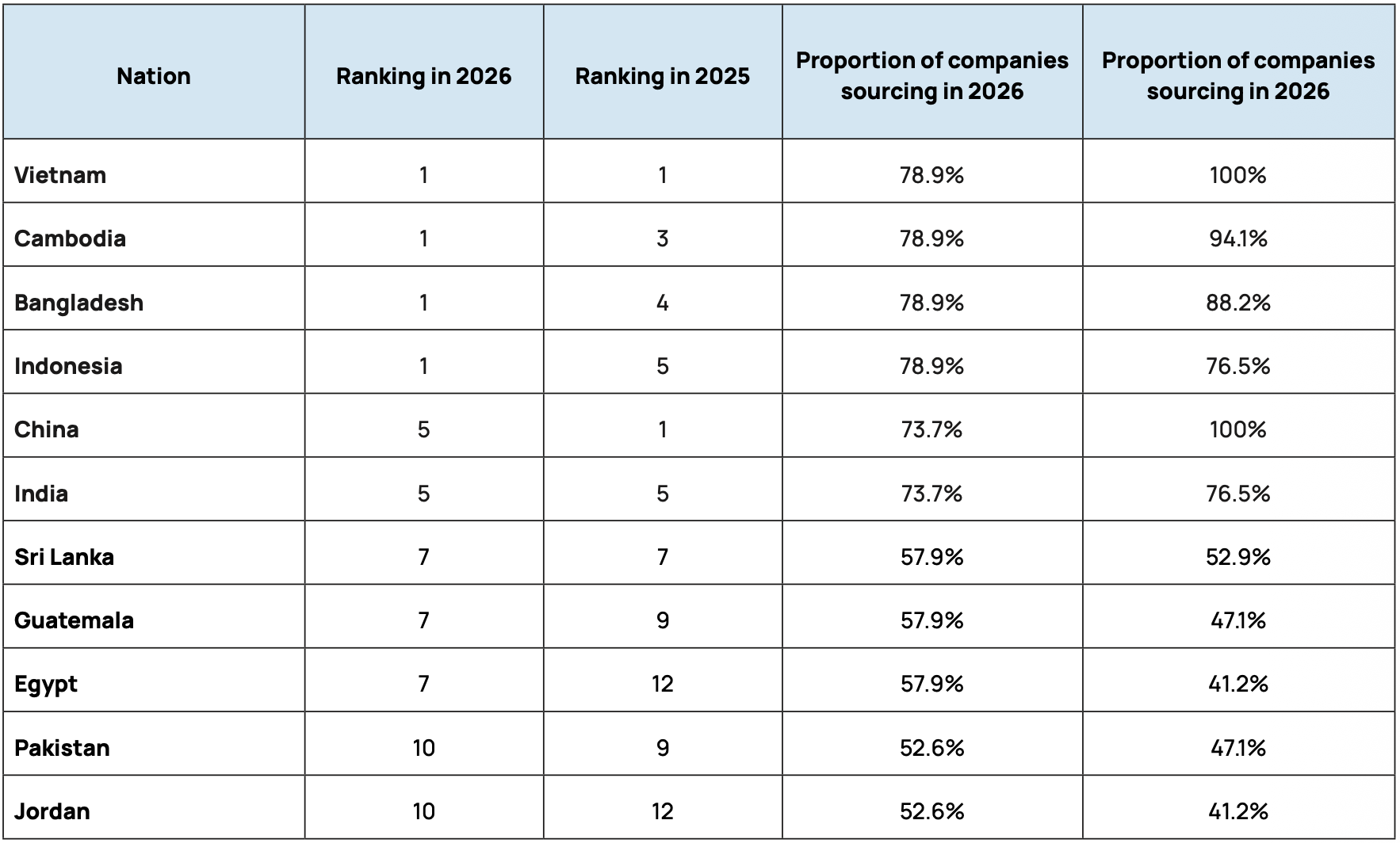
The USFIA survey was conducted from April to June 2026 among managers from 30 U.S. fashion companies, approximately 80% of which employ more than 1,000 people. As the survey was completed before the final Section 301 rates were announced on July 24, its findings do not directly reflect companies’ responses to the new policy. Nevertheless, they offer valuable insight into the sourcing landscape immediately before the new tariffs took effect. Vietnam ranked among the most widely used sourcing destinations, with 78.9% of respondents reporting that they sourced from Vietnam, on par with Cambodia, Bangladesh and Indonesia, and higher than China and India, both at 73.7%. During the first five months of 2026, Vietnam remained the leading source of U.S. apparel imports, accounting for approximately 22.2% of import value by market share. Around 58% of surveyed companies continued to source more than 10% of their total apparel volume or value from Vietnam.
More noteworthy is the quality of Vietnam’s competitive position. On a scale of 1 to 5, Vietnam scored 3.9 for cost competitiveness, 3.6 for flexibility and adaptability, 3.5 for vertical integration, and 3.1 for its ability to accommodate minimum order quantities (MOQ). Among Asian sourcing destinations, Vietnam ranked second only to China in flexibility and demonstrated a relatively balanced competitive profile. Bangladesh stood out for cost competitiveness but scored lower on MOQ, while both Bangladesh and Cambodia recorded lower scores than Vietnam for vertical integration.
This competitive foundation gives Vietnam greater resilience against the 2.5-percentage-point tariff disadvantage. For orders requiring technical expertise, fast delivery, flexible volumes, or close coordination in product development, the costs and risks associated with switching suppliers may outweigh the direct benefit of the tariff differential. In such cases, buyers do not make sourcing decisions based solely on FOB prices.
However, the outlook is more cautious. Over the next two years, approximately 33% of companies expect to increase sourcing from Vietnam, lower than Indonesia (53.3%), Bangladesh (46.7%), and Guatemala (40%), while around 7% expect to reduce sourcing from Vietnam. Vietnam scored 2.8 for speed to market and 2.0 for the risk of facing additional U.S. import barriers; for comparison, India scored 1.9 and China scored 1.6. This suggests that, at present, Vietnam is among the three sourcing destinations considered most exposed to the risk of significant additional U.S. trade barriers among the locations assessed by USFIA. The picture is therefore two-sided: Vietnam has a strong competitive position, but it is no longer the sourcing destination with the greatest room for expansion.
2027: Competition is shifting from “Which Country?” to “Which Supplier?”
Sourcing strategies are shifting from rapid expansion toward network optimization. In 2025, 58.8% of companies expected to source from more countries; by 2026, this figure had fallen to just 21.1%. The share of companies planning to increase the number of suppliers declined from 41.2% to 26.3%, while the proportion seeking to reduce their supplier base rose sharply from 17.6% to 47.4%.
Companies with stable customer relationships, sufficient scale, strong product development capabilities, robust data systems, and solid compliance practices are better positioned to secure additional orders as buyers consolidate sourcing among a smaller number of strategic partners. Conversely, factories that offer little more than production capacity, provide limited differentiation, and lack the ability to coordinate inventory management, product development, or supply-chain traceability may be dropped from supplier lists — even if Vietnam maintains a high market share.
Competition is not limited to countries with lower tariff rates. Notably, even amid the tariff environment and policy uncertainty before July 24, China still received a cost competitiveness score of 4.3 from surveyed companies, on par with Bangladesh and the highest among the destinations assessed. China also continued to lead in flexibility, minimum order quantity (MOQ) capabilities, and vertical integration. The share of companies expecting to reduce sourcing from China over the next two years has fallen from more than 80% to 40%, while 20% expect to increase their sourcing. This suggests that the process of reducing dependence on China may be entering a slower phase, as the remaining capabilities are more difficult to replace in terms of material availability, speed, and the ability to handle complex orders.
Nearshoring in the Western Hemisphere is also gaining momentum, as reflected in the share of companies sourcing from CAFTA-DR countries, which increased from 64% to 76%. However, USFIA data show that sourcing from the region remains concentrated in product categories such as T-shirts, activewear, and bottoms. Limitations in scale, product variety, and raw-material capabilities mean that the region is not yet able to broadly replace major Asian sourcing hubs.
Tariffs Are Being Passed Through to Prices — but July 24 Was Not an Entirely New Shock
The impact of tariffs on consumer prices does not occur immediately. A Federal Reserve study, “Detecting Tariff Effects on Consumer Prices in Real Time,” published in April 2026 and based on the tariff increases introduced in 2025, estimated that cumulative tariff pass-through reached approximately 55% after three months, 75% after four months, and 90% after five months. By around the seventh month, the estimated pass-through was consistent with full 1:1 pass-through. Sensitivity tests in the same study indicated that the pass-through process could take approximately 5–9 months to stabilize at around 100%. Here, “1:1” does not mean that a 10% increase in the tariff rate would result in a 10% increase in the retail price. The Fed explains that if a tariff increases a retailer’s purchasing cost by USD 1, then once the pass-through process is complete, the selling price would increase by approximately USD 1.
These findings do not directly measure the full impact of Section 122 and Section 301 tariffs in 2026, but they provide a useful benchmark. The 10% surcharge under Section 122 took effect on February 24 and remained in place for exactly five months before expiring on July 24. If the 2026 pass-through process follows a similar pattern, a significant portion of the impact of the 10% surcharge may already have been reflected in prices before July 24. As Section 301 subsequently maintained a 10% rate for many sourcing destinations while raising the rate to 12.5% for Vietnam, the market is not starting an entirely new adjustment cycle. For Vietnamese goods subject to both mechanisms, the incremental tariff shock is essentially 2.5 percentage points. Therefore, in the remaining months of the year, the residual impact of the 10% tariff may continue to be passed through to prices, while the additional burden on Vietnamese goods begins to be absorbed.
However, suppliers will also bear part of the burden. According to USFIA, 84.2% of fashion companies experienced lower profits, 73.7% faced higher sourcing costs, 57.9% increased selling prices, and 52.6% saw sales decline in the U.S. market. As consumers respond to higher prices, brands are likely to return to negotiations over unit prices, adjust order volumes, extend payment terms, or shift orders to alternative suppliers.
Vietnamese Textile and Garment companies therefore should not accept across-the-board price reductions simply because customers cite tariffs as a justification, but neither should they assume that buyers will absorb the entire additional cost. Pricing strategies should be assessed on a product-by-product basis, considering the MFN rate, Section 301 tariff, price sensitivity, supplier substitutability, switching costs, productivity, and minimum acceptable profit margins.

Maintaining Market Position in the Years Ahead: From Production Advantages to Strategic Value
First, compliance and traceability must evolve from control functions into commercial capabilities. According to the USFIA survey, 68.8% of companies plan to adopt new technologies to gain greater visibility into their supply chains, while 62.5% will continue tracing the origins of fibers and yarns, 56.3% will require additional social compliance data, and 31.3% plan to reduce the number of suppliers or slow the approval of new suppliers. Comprehensive traceability records could directly determine whether a supplier remains on a buyer’s approved list as sourcing networks are consolidated. Information on the origins of cotton, yarns and fabrics, labor practices, and country-of-origin transformation must therefore be maintained as readily accessible and verifiable data.
The industry needs to translate its flexibility advantage into greater speed and higher value-added. Vietnam’s flexibility score of 3.6 is a clear competitive advantage, but its speed-to-market score of 2.8 indicates room for improvement in sample development, material approvals, production organization, and logistics. Deeper investment, automation, digitalized production planning, shorter line changeover times, and stronger design and product development capabilities will have a more direct impact than simply expanding production capacity. The product mix should also shift away from easily replaceable basic items toward technically sophisticated orders, flexible production volumes, and fast delivery.
Upstream opportunities in Japan, South Korea, and Jordan arising from tariff differentials should be approached selectively and subject to clear conditions. Tariff advantages for finished goods could generate additional demand for raw materials, but only when rules of origin, technical standards, logistics requirements, and payment security are fully satisfied. Companies should assess customer demand, pilot orders, and quantify the potential returns before scaling up, and should never rely on transshipment as a means of circumventing rules of origin.
Finally, performance must be measured by financial outcomes and the quality of growth. Tariffs, labor costs, energy, and logistics alone cannot fully explain any decline in profitability. Productivity improvement, cost-saving, and defect-reduction initiatives must be translated into measurable financial gains; profits must be converted into cash flow; and growth must be accompanied by improvements in employee income and working conditions. These are also essential to retaining a stable workforce and maintaining the position of Vietnamese companies as strategic suppliers.
Conclusion
The tariff policy introduced after July 24 puts Vietnam at a relative disadvantage compared with several competitors subject to lower tariff rates, but it has not fundamentally altered the position of Vietnam’s textile and garment industry within the U.S. supply chain. Vietnam remains one of the key sourcing destinations, with a relatively balanced competitive foundation in terms of cost, flexibility, and supply-chain integration. Experience from previous tariff measures also shows that their primary impact has been to adjust and redistribute orders among sourcing destinations, while the potential for bringing apparel manufacturing back to the United States remains relatively limited.
In 2027, competitive pressure is expected to intensify as brands both rebalance sourcing across countries and increasingly concentrate orders among higher-performing suppliers. Vietnam’s ability to maintain and expand its position will therefore depend on continued improvements in productivity, speed, flexibility, product development capabilities, traceability, and compliance. Tariff disadvantages must be actively managed, but the position Vietnam has already established within global supply chains remains an important foundation for the country’s textile and garment industry to compete and capture opportunities in the years ahead.