
On September 9th, the Vietnam National Textile and Garment Group (Vinatex) held its September Market Outlook Seminar to review the Group’s production and business performance during the first eight months of 2026 and offer an outlook on the market for the final four months of the year. Mr. Le Tien Truong, Chairman of Vinatex, chaired the seminar. Also attending were Vinatex General Director Cao Huu Hieu, leaders of the Executive Office and Departments of the Group.
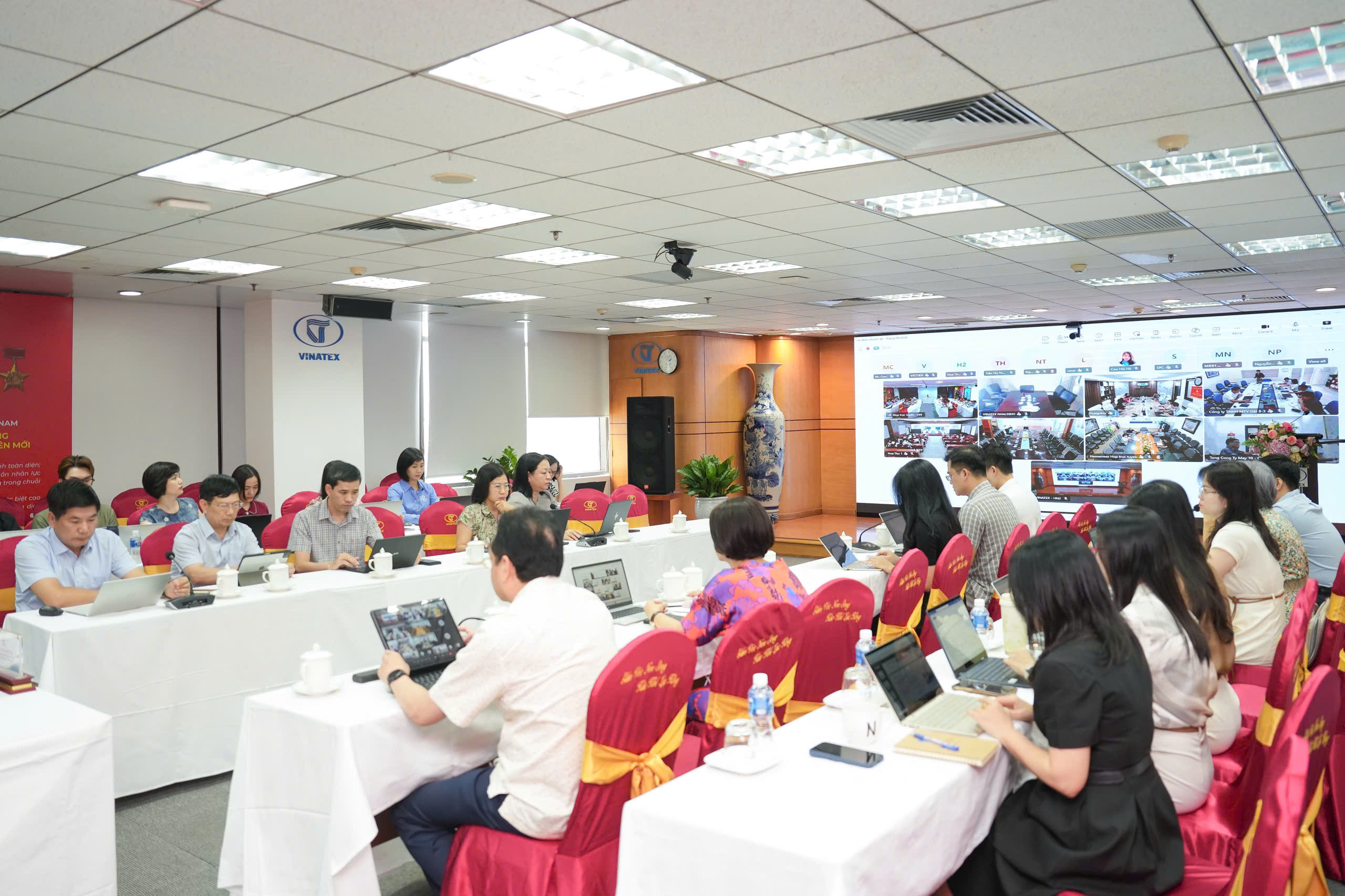
Reporting on business performance in the first eight months and tasks for the remainder of 2026, Mr. Cao Huu Hieu – President & CEO of Vinatex said that, despite continued volatility in the global textile and garment market, Vinatex has maintained a positive performance trend, particularly in efficiency and adaptability.

Vinatex’s estimated results for the first eight months show consolidated revenue increasing by 8.3% year-on-year, while profit before tax rose by 39.3%. Notably, the PBT margin improved from 7.4% to 9.5%. By business segment, the Yarn sector was a standout performer, with revenue increasing by 18.8% and profit nearly tripling year-on-year. The Towel sector maintained its growth momentum with revenue up by 19.4% and profit up by 37.3%, while the Weaving – Dyeing sector recorded a significant improvement in efficiency. The Garment sector also recorded a 3.9% growth in revenue, but faced considerable pressure in terms of profit margins amid fierce price competition, smaller orders and shorter delivery lead times.
Export markets have remained relatively stable. The Garment sector has secured orders through the fourth quarter, with some units already fully booked and already receiving orders for early 2027. The Yarn sector’s orders for September are basically sufficient, although the order coverage from October onwards varies across units. For the first nine months, Vinatex expects consolidated revenue to increase by roughly 7.3% and profit before tax by 37.8% year-on-year, exceeding the full-year profit target.
For the final four months of the year, General Director Cao Huu Hieu stressed that significant risks remain, including fluctuations in cotton and fiber prices; exchange-rate pressure as the VND/USD rate trends upward; weakening demand in the US and EU; rising logistics and raw-material costs; increasingly stringent rules of origin and trade-remedy requirements; and growing competition from Bangladesh, China and other textile and garment-producing countries.
On this basis, General Director Cao Huu Hieu called on all member units to protect profit margins and the quality of growth by maintaining the results achieved during the first eight months. Main tasks include: tightly controlling cash flow, receivables, inventories and capital efficiency; improving productivity and reducing costs; completing the 2026–2030 medium-term investment plan; closely monitoring markets and US tariff policies; updating management scenarios and preparing the 2027 plan; accelerating the implementation of the management dashboard and data standardization. For the Yarn sector, the focus is on closely monitoring cotton and fiber prices, purchasing raw materials cautiously and ensuring sufficient supply. For the Garment sector, units should review low-efficiency products and customers, coordinate orders and capacity, retain strategic customers and prepare orders and resources for the year 2027.

At the seminar, Mr. Hoang Manh Cam, Chief of the Board Office, updated participants on macroeconomic developments, textile and garment trade, and raw-material markets. Major markets continued to show divergent trends. The US market witnessed the second-quarter 2026 GDP growth of 1.5% year-on-year, slower than that of the first quarter. Clothing retail sales in July also rose 6.5%. EU GDP grew 1.4% in the second quarter and retail sales increased 1% in July. Meanwhile in Asia, Japan’s second-quarter GDP grew 1.4%, with retail sales up 4% in July, although clothing sales fell 6.6%. South Korea’s GDP grew 3.7%, while July retail sales declined 0.8%. In China, July retail sales increased only 0.6%, with clothing sales down 1%.
Import trends also diverged. In the first seven months, US textile and garment imports dropped 7.7%, including a 9% decline in apparel and a 5% decline in textile and yarn products. EU imports fell 8% in the first six months compared with the same period in 2025. In contrast, Japan’s imports increased 6.6% in the first seven months of 2026, while South Korea and China recorded growth of 1% and 24%, respectively.
Most notably, Vietnam continued to lead major textile and garment exporters in export turnover growth. In August 2026, textile and garment exports reached USD 4.8 billion, up 8.1% year-on-year, with textiles and yarn increasing 40% and apparel 3.2%. In the first eight months, exports reached USD 33.02 billion, up 6.7%; textiles and yarn increased 37.4%, while apparel rose 1.6%.
Among competing countries, China’s textile and garment exports increased by 2.4% in the first seven months of 2026, while Bangladesh recorded 3% growth in the first eight months. India’s exports declined by 5.4% in the first half of the year, while Indonesia’s textile and garment exports increased by 3% in the first seven months. These figures indicate that textile and garment trade among major producing countries remains uneven across markets and product categories.
Regarding raw materials, the USDA’s August forecast indicated that global cotton production for the crop year 2026/2027 would decline 3.8%, while consumption would rise 1.9%, pointing to continued volatility in cotton prices. PSF prices were also trending upward in early September, with future developments depending significantly on the situation in the Middle East and polyester raw-material supply in China.
Another key topic at the seminar was China’s market and export policies and their impact on the textile and garment industry. Mr. Hoang Manh Cam noted that the imbalance between China’s large production capacity and weak domestic demand is increasing its reliance on exports. With industrial production accounting for around 30% of global output while domestic consumption recovers slowly, surplus goods are increasingly entering international markets, intensifying price competition in textiles and garments, yarn, chemicals and raw materials.
China’s advantage lies not only in production scale but also in its integrated supply chain, from raw materials, spinning, weaving and dyeing to apparel, machinery, technology and logistics. Investment in textile and garment development in Xinjiang, transport infrastructure and value-chain upgrades indicate a shift from volume-based competition toward quality, branding and supply efficiency.
However, China’s export strategy faces increasing pressure as the US and G7 economies tighten requirements on rules of origin, supply chains, environmental standards and labor practices. The “China + 1” strategy is also changing as the tariff gap between China and other textile-producing countries, including Vietnam, becomes less significant. Consequently, in 2027–2028, competitive advantages are expected to favor companies that can control product origin, increase localization rates, shorten delivery times and build transparent supply chains.

Concluding the seminar, Mr. Le Tien Truong, Chairman of Vinatex emphasized that, amid rapidly changing market conditions, Vinatex’s units must shift their focus from scale expansion toward greater efficiency, improved profit margins and higher-quality growth.
For the Yarn sector, companies should closely monitor cotton prices, control raw-material quality and avoid low-quality cotton that could affect products and customers. Customer and market diversification is also a must to avoid dependence. For the Garment sector, the priority is no longer simply securing sufficient orders but improving profit margins. Enterprises should review their production models, customer structures, product mix and business approaches. KPI systems should include indicators reflecting efficiency and profit margins rather than focusing only on revenue, profit and dividends.
Vinatex’s members should also accelerate technology adoption and diversify currencies used for import-export payments. In terms of financial management, dependence on bank loans should gradually be reduced while funding from equity, partners and major customers should be increased to lower capital costs and improve operational autonomy.
Regarding China, Mr. Le Tien Truong stressed that a divergence between economic growth and purchasing power in China is noteworthy. GDP is still growing at around 4.5%, while total retail sales have increased only 0.6%, indicating that consumer spending and household incomes have not improved proportionately. Growth is driven mainly by government investment in high technology, AI, semiconductors and automation, while investment in private sector and real estate has dropped 9.2% and 20% respectively, and traditional industrial sectors have inched up by only 4.5%. This is creating a “two-speed” economy, with high-tech sectors accelerating while traditional manufacturing and domestic consumption remain under pressure.
In this context, Vietnamese textile and garment enterprises need to view China both as an important consumer market and as a key force shaping the global market. As the US–China competition shifts from a tariff war toward a long-term race in technology, supply chains and trade influence, Vietnam must avoid excessive dependence on a single market. Closely monitoring China’s demand, raw-material prices and production capacity will be critical for proactive production planning, inventory management and cash-flow control.