
Facing competitive pressure and market volatility, and in line with many enterprises within the Vinatex system, Hoa Tho Textile – Garment Joint Stock Corporation (Hoa Tho) has accelerated its digital transformation efforts to optimize processes, reduce costs, and enhance its capability and adaptability in production and business operations.
Mr. Nguyen Ngoc Binh – General Director of Hoa Tho – stated that the company identifies digital transformation as its key breakthrough for 2025, targeting “three improvements”: higher work efficiency, higher revenue, and greater customer satisfaction, along with enhanced decision-making and information security.
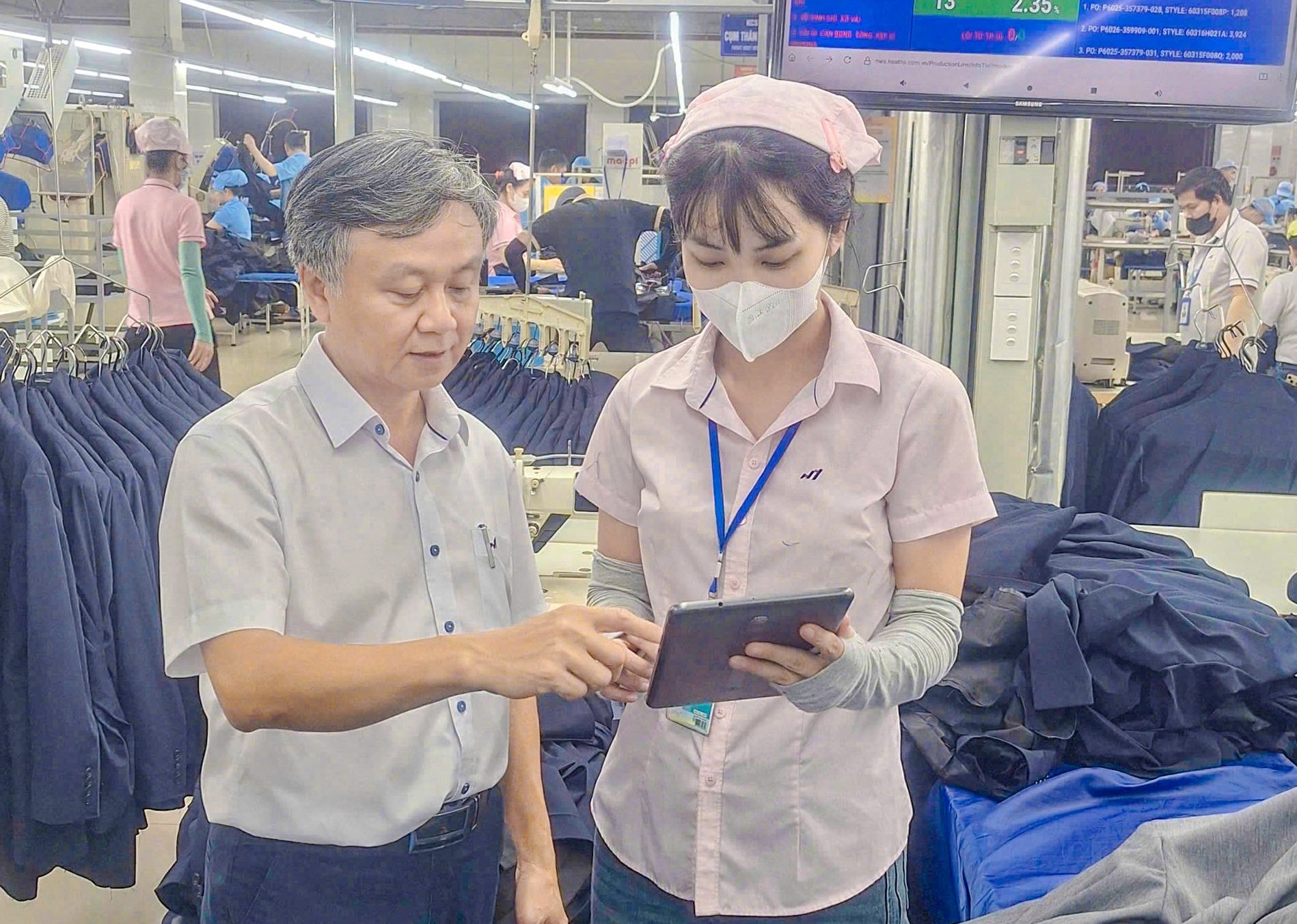
In the first 10 months of 2025, Hoa Tho accelerated comprehensive digitalization through an ecosystem of applications such as customer data linking, MES, ERP for Spinning–Garment, Bravo 10, equipment management, Power BI, e-Office, and electronic signatures. Notably, the MES and ERP Spinning–Garment–HRM systems have delivered clear, measurable results and significantly contributed to the company’s growth.
MES application – controlling productivity, quality, and lost time on sewing lines
Mr. Phan Nhat Long, Head of IT at Hoa Tho, shared that the MES application was developed in January 2025, with version 1.0 completed at May 1 and now being expanded to factories: Veston, Dien Ban, Duy Xuyen, Hoi An, and Que Son.
MES digitizes the entire production process from the raw materials warehouse, cutting department, sewing lines to the finished-goods warehouse, replacing manual paperwork. The system enables control of productivity, quality, and time losses, thereby improving efficiency and reducing defects. MES also creates a unified management data channel, integrated with ERP to update production progress, inventory levels, and order information.
The application of MES in the Raw and subsidiary material warehouse shows clear improvements:
BEFORE
- Manual warehouse receiving; unable to assign unique IDs to each fabric roll
- Raw material requirement sheets created on paper; inventory report via Excel
- Fabric inspection reports (4-point system) prepared manually on paper
AFTER
- Sync goods delivery note from ERP central warehouse as MES goods received note
- Automatically generate Bill of Materials requirement (BOM)
- Signing confirmation in the system for raw material in/out transactions
- QR code scanning for each fabric roll to update the 4-point-system (4S) fabric report
MES application at the Cutting Department shows:
BEFORE
- Daily cutting plans tracked on paper
- Manual entry of fabric-spreading sheets at cutting tables
- Monitoring reports manually in Excel
AFTER
- Daily cutting plans viewable directly on the system
- QR code scanning to update fabric roll information for each cutting table and trace products cut from specific rolls and tables
- Automatic tracking of cutting table status
MES application on sewing lines shows:
BEFORE
- Quality report done manually on paper
- No real-time data on line output, defect rates, or time losses
AFTER
- Error control by production process and automatic quality control reporting
- Real-time, visual monitoring of productivity and quality at each module with timely issue resolution
- Ability to track and control production time losses
Applying MES in the Finished-Goods Warehouse shows:
BEFORE
- Recording purchase order – style information on boards for location identification
- Using Excel to track inventory reports
AFTER
- Updating purchase order by each specific location in the warehouse
- Scanning QRcode to identify locations in the warehouse
- Creating a warehouse map and enabling fast, accurate location-based searching
According to Mr. Phan Nhat Long, MES delivers obvious benefits by replacing up to 90% of manual operations in the factory. Sewing lines no longer need Standard allowed minutes (SAM) reports, the raw-material warehouse significantly reduces fabric-inspection paperwork and goods delivery/received note, and the cutting department cuts down 70% of its paperwork costs.
The system enables monitoring of output and productivity by hour and by line, early defect detection to minimize waste, and supports line balancing, workforce optimization, and equipment efficiency. With real-time data, management and decision-making become more transparent and faster, creating a foundation for continuous improvement and digital transformation.
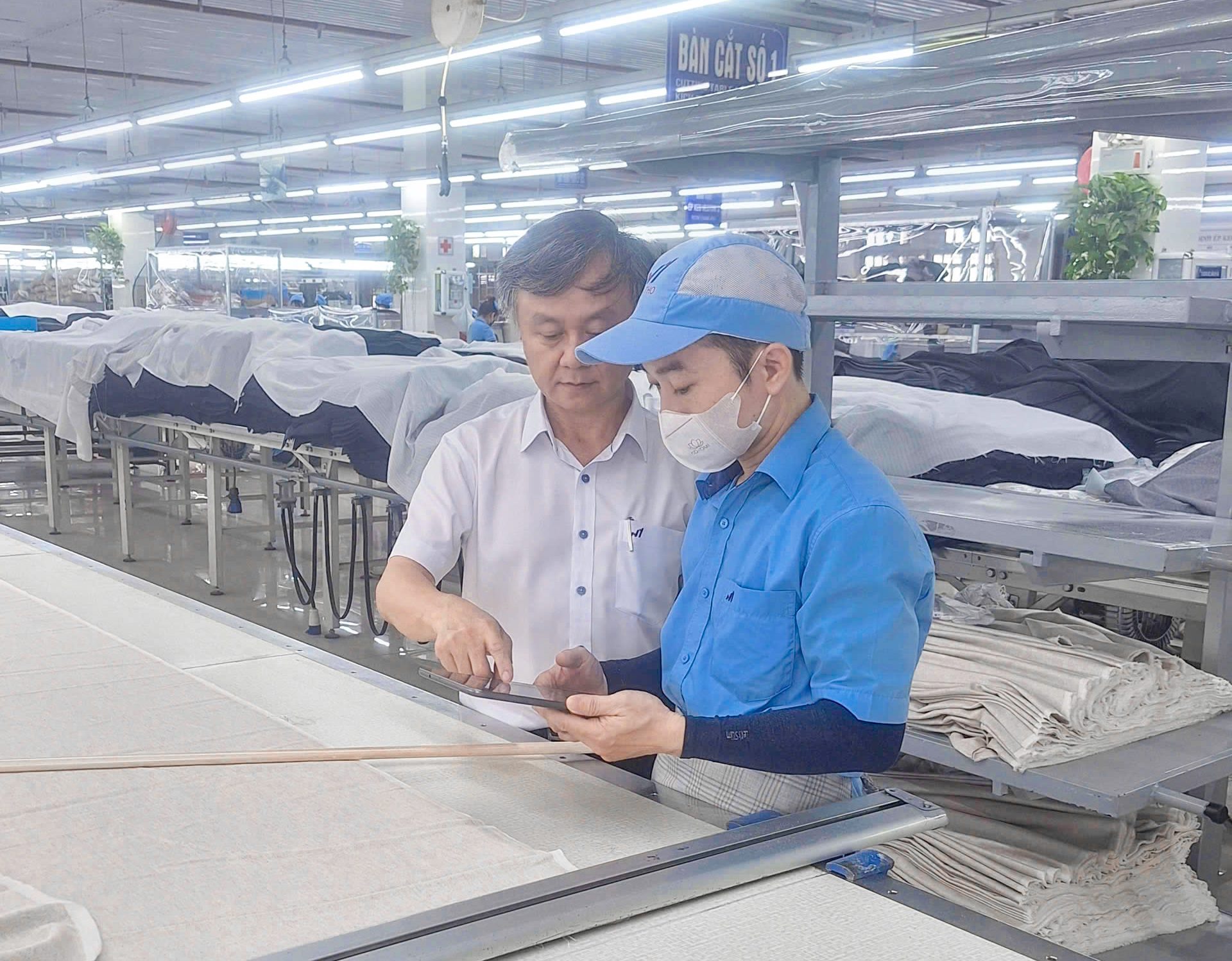
Applying ERP for Spinning – Sewing – HRM: the core data foundation for management reporting and digital transformation
The Spinning ERP system has been deployed by Hoa Tho in the Sale Department, Technical Department, Accounting, and all member Factories. It centralizes order information management from sales to production, from planning, production progress, product quality, to delivery.
Order tracking:
Before using ERP
- Order monitoring and execution were managed separately by each department using Excel.
- Looking up order status by calling, email, Zalo the related departments to manually request and summerize information.
When managing orders centrally on ERP
- Orders are centralized in the system and quantities are broken down by each export container.
- Departments jointly update information on production, quality, raw-material origin, export documentation, and liability for each container.
- Data is complete, centralized, and easy to access and manage.
With production reporting:
Before using ERP
- Production data at each process was written on paper and then entered into Excel. The factory compiled and processed this into Excel reports and sent them to relevant departments.
- Manual report processing was slow and vulnerable to errors.
Digitizing production data
- Production data is digitized and managed by shift.
- Reports are processed automatically, quickly, and likely to avoid errors.
- Output from individual machines/cones is linked directly to purchase orders.
Product quality
Before using ERP:
- Cotton testing data from the Uster machine was stored in separate Excel files.
- Cotton blending formulas were managed in Excel, with manual tracking of each cotton bale used.
When integrating ERP and EFS:
- Quality data (from Uster machines) and U.S. cotton data (USDA) are imported into ERP and EFS.
- Cotton blending formulas are managed in EFS and imported into ERP to generate receipt.
- Raw-material traceability is managed through ERP.
Hoa Tho has implemented the Garment ERP system for the sales, import–export, accounting departments, and all member garment factories to manage the entire order lifecycle: from receiving orders, balancing raw-material purchases, warehouse in–out transactions, planning, and progress tracking, to delivery, revenue recognition, and receivables. The system enables quick traceability of purchase prices, origin, the proportion of raw materials from China, brand and licensing information, all with accurate and automated data.
The ERP HRM (Human Resources Management) system is applied across all units, consisting of three main modules: HR – Time Attendance – Payroll. The time-attendance and payroll modules are fully integrated, meeting all operational requirements and completely replacing Excel, allows employees to view and confirm their salary directly on mobile devices.
Hoa Tho will continue upgrading its network infrastructure and server systems to ensure stable, high-speed operations from the Corporation to its factories. The company is also exploring the integration of new technologies such as AI, IoT and coordinating with the Group’s Data Information Center to build a robust security system that supports comprehensive digital transformation.