
It can be said that building competitive capacity within a business ultimately comes down to “managing the entire system for high performance.” Here, performance is a broad concept encompassing fixed assets, current assets, and the most “opaque” and difficult-to-measure area: human performance. This article focuses primarily on the link between training, assessment, and the work performance of managers, which serves as the driving force generating overall system performance.

Defining the performance improvement framework for managers
To clearly understand performance, a proper measurement method is essential. For managers, this involves a process that begins with:
(1) job description,
(2) setting measurable tasks and objectives (KPIs),
(3) providing training and coaching to meet assigned responsibilities,
(4) periodic performance evaluations
(5) additional training and coaching based on identified limitations or new requirements revealed during the evaluation process.
During the 2021–2025 period, the Vietnam National Textile and Garment Group (Vinatex) implemented numerous training programs, while the parent company applied various human resource evaluation methods. This timeframe is long enough to be regarded as a complete performance enhancement cycle for managerial staff. It is now the right moment to reflect and define the direction for the next cycle, 2026–2030, in line with one of the three fundamental principles of dialectical materialism — the law of the negation of negation. With two characterized by objectivity and inheritance: the first negation creates something new in opposition to the old, while the second negation allows a return to the original foundation — but at a higher and more advanced level.
How to approach this second cycle effectively, with the right methodology, and most importantly to elevate it to a higher level for the 2026–2030 period, we must first take a step back and review what has been accomplished during the first cycle (2021–2025).
Multi-dimensional human resource evaluation
The management and development process for high-level human resources, from a practical implementation perspective, can be outlined in 5 key tasks:
(1) Strategic workforce planning,
(2) Recruitment, training, retraining, workforce expansion,
(3) Job assignment, task allocation, and performance evaluation,
(4) Treatment, rewards, and disciplinary actions,
(5) Personalized career development programs for high-potential individuals.
Among these, performance evaluation plays the most critical role, serving to accurately identify and individualize training needs, as well as to formulate career development plans for senior personnel. It acts as the primary input and informational foundation for the entire five-step process.

Between 2022 and 2024, the Parent Company gradually introduced new evaluation methods for its personnel to gain a more comprehensive and multi-dimensional view of each employee’s competence, contribution, and work attitude. The process began with 360-degree assessments for department-level managerial staff up to the Group’s Chairman, and starting in 2023, was expanded to cover 100% of employees at the Parent Company.
This is the first time, each employee at the Group received a personal performance profile reflecting how they are perceived by their peers, subordinates, and supervisors, compared to their self-assessment, across 3 key dimensions: professional knowledge, problem-solving skills, work responsibility and attitude.
However, while the 360-degree evaluation provided numerical scores for each dimension, it remained highly qualitative, depending heavily on the subjective perception and positional perspective of the evaluators. As a result, those being evaluated could not precisely identify which specific areas required improvement, adjustment, or new development, the results only offered a general overview of knowledge, skills, and responsibility. Therefore, if the process stops at the 360-degree stage, it would be extremely difficult for employees to formulate an effective and actionable Career Development Plan (CDP) for themselves.
From this scientific understanding, and to further refine the performance evaluation process, in 2024, the Group introduced an additional component: one-on-one performance review. Under this model, 100% of employees and department-level managerial staffs at the Group had a direct, individual discussion with their immediate supervisors. During these meetings, both parties reviewed and discussed the individual’s achievements and limitation over the year of 2024. The one-on-one evaluation was based on each employee’s assigned tasks and personal KPIs, the level of KPIs completion assessed objectively, discussed, and documented in written self-assessment reports reviewed together with the direct manager. The results were classified and scored on a five-point scale (from 1 – Poor to 5 – Excellent), accompanied by a discussion on the employee’s career development plan for the following year. By the end of 2024, the Parent Company’s performance evaluation system had therefore combined both 360-degree assessments and top-down annual evaluations. Comparing this to the full feedback loop model, one missing component remains: the bottom-up one-on-one feedback channel, where subordinates proactively provide feedback, suggestions, and proposals to their managers. Increasing the frequency of such exchanges (to more than once a year) would allow for timelier improvements, preventing year-end results from reflecting unresolved issues.
The impact of multi-dimensional evaluations over the past 3 years has become evident. We have accurate basis for assessing employee performance at all levels — serving as an input for training, development, succession planning, and promotion decisions.
With individualized reports combining both 360-degree feedback and one-on-one evaluations, each employee has gained a more accurate understanding of their strengths and weaknesses, allowing them to develop concrete improvement plans. After 3 consecutive years of assessment, employees have shown notable proactive progress in both work quality and productivity.
Moreover, the evaluation standards and self-assessment criteria have been refined annually, becoming more precise with defined benchmarks. The distribution of scores has also become more concentrated, reflecting an increasing level of consensus within the organization regarding individual performance, particularly in the area of problem-solving capability.
Internal training and coaching
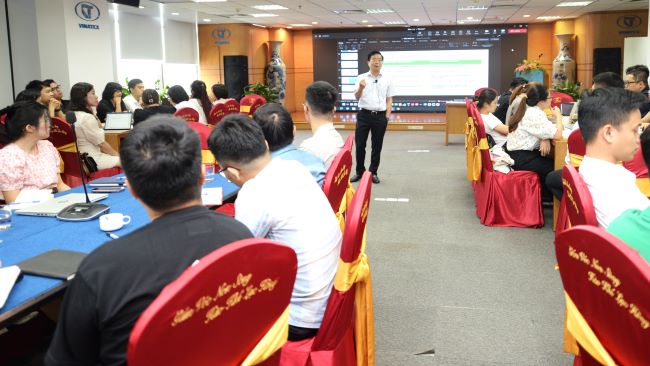
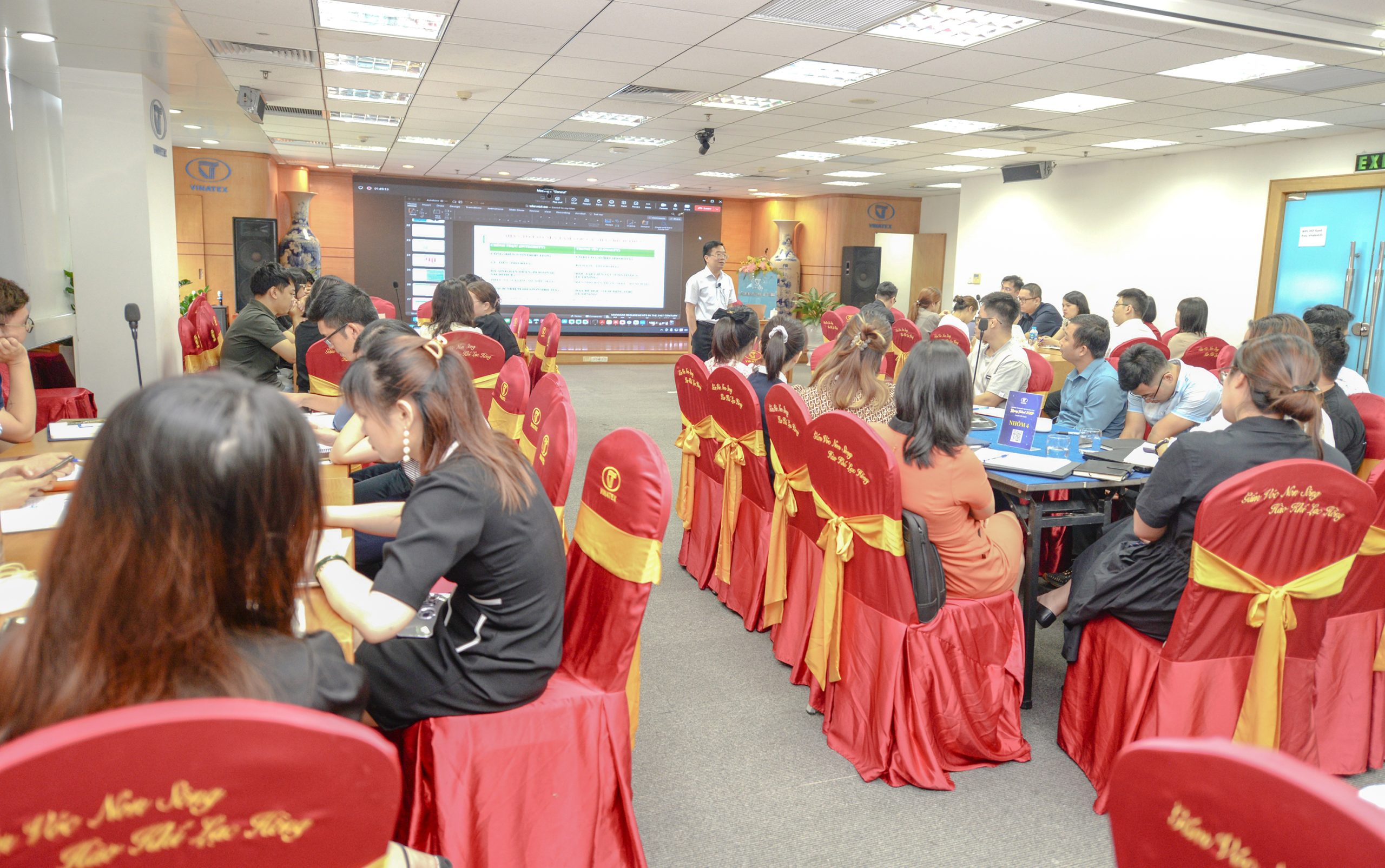
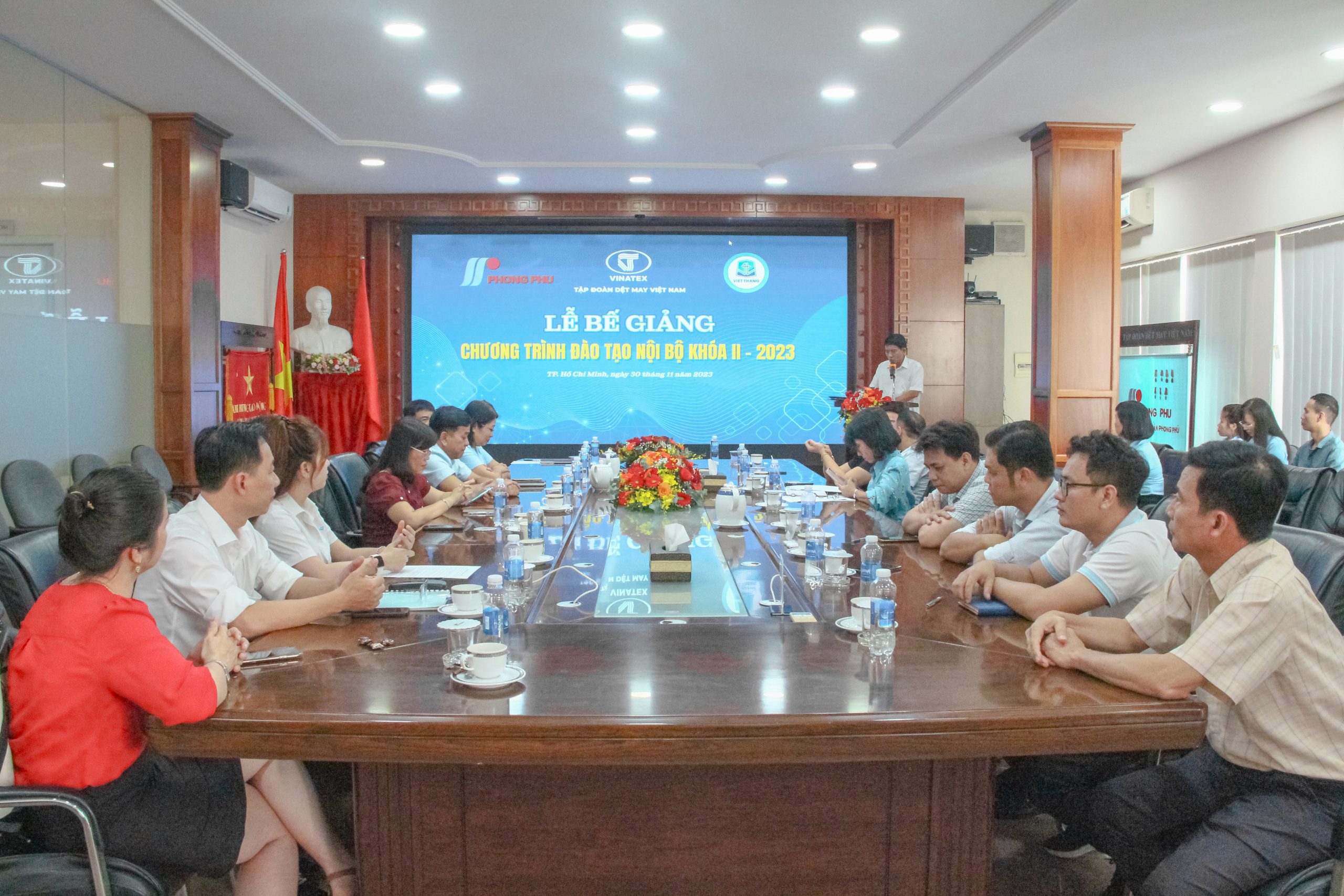
Since 2021, the Group’s internal training activities have been systematically designed, with concrete annual plans. The program began with general lectures on management theory: financial management, human resources, marketing, and production—delivered widely to large classes through a blended format combining online and in-person learning. In subsequent years, the internal training system gradually shifted toward specialized courses tailored to the specific needs of textile and garment enterprises. These courses particularly emphasized case studies developed specifically for the Group’s business model, based on field surveys to ensure relevance. Starting in 2022, the Group also designed and organized separate programs for senior executives within its companies (CEOs, Deputy CEOs, and Managing Directors of member companies), as well as a “young talent” program for high-potential staff. All teaching content, materials, and instructors were drawn from the Group’s leadership, enterprises, institutions within the Group, with a few external experts invited as needed. This marked an important milestone in the Group’s ability to design and manage its own training programs, affirming its capacity to deliver high-level internal training that harmonizes modern management theory with the Group’s unique vision, mission, strategy, and characteristics. Since 2023, the Group’s training division has also begun handling specialized training requests from individual enterprises, such as Phong Phu Corporation, Viet Thang Corporation, and Hung Yen Garment Corporation. This marked the beginning of a hybrid approach combining formal training with on-site mentoring. At the same time, 2 industry-specific business divisions—Spinning and Garment were established, along with a unified KPIs system applied across enterprises in the same sector. This created a shared performance measurement framework at both the corporate and departmental/team levels. The establishment of this common “language” has encouraged enterprises to self-identify weaknesses and fostered a genuine drive for learning and improvement. The activities of the Spinning and Garment divisions, together with the KPI system, benchmarking practices, and the adoption of best practices from top-performing units, have effectively transformed theoretical training knowledge into concrete performance improvement actions. Most notably, the shift from top-down training requirements to bottom-up learning demand—wherein frontline staff and professional teams proactively identify their own training and self-development needs—has been a breakthrough. After 5 years of implementation, a culture of training, learning, and continuous improvement has taken root across the Group. However, this highly individualized demand now presents a new challenge for the next phase of training: how to meet increasingly detailed and diverse needs across multiple fields and enterprises in practice.
New Requirements for the 2026–2030 Period
As presented above, the successes achieved during the 2021–2025 period in training and human resource development have led to significant improvements in the performance of managers at all levels. However, for those who have completed the first training cycle, there is now an urgent need for hands-on guidance and mentorship—having a “coach” to help them apply the knowledge they have acquired into real work situations. The training programs from the 1st cycle will continue to be maintained to equip new and younger managers, though the number of participants will be considerably smaller than during the initial rollout. The design of the 2nd cycle programs will focus on providing enterprise-specific consulting and practical guidance, this is the new objective. The most important question is: Who will serve as the trainers or coaches for these consulting-based programs? Should they be outsourced or drawn from within the organization? What role should senior managers at the enterprise level play in upcoming training and coaching programs, or will the instructors continue to be those from the Group’s central training team?
Similarly, in the area of staff evaluation, there is an urgent need for a comprehensive and scientifically designed KPI system for various job positions, serving as a SMART basis for performance assessment. At the same time, it is essential to establish a one-on-one communication channel in which subordinates take the initiative to meet with their direct supervisors to present suggestions or request support in achieving their monthly KPIs with the duration about one hour per person, thereby completing the feedback loop in the performance evaluation process.
A New Approach to Training Activities for the 2026–2030 Period
Preparing for a qualitative breakthrough, turning training activities into a true driver of system-wide performance improvement is highly challenging and complex. However, it cannot be undone because if maintaining the old model from phase 1, the effectiveness of training would no longer be as evident or impactful as in the previous cycle. In essence, this situation is similar to a familiar concept in our textile and garment industry: moving up the value chain from simple processing, FOB and then to ODM, once the profit margin from basic manufacturing disappears. The new approach to training in Cycle 2 can therefore be seen as the ODM level (training as a fully designed). So, in this “training ODM” model, who will do what? Broadly, the responsibilities should be divided as follows:
– The design of training programs in each area must be the responsibility of the head of that area. For example, the Factory Director in a manufacturing facility, the Department Head in an office unit, and the Chairman or CEO at the company or group level. It is neither feasible nor financially sustainable to hire external consultants to design or implement these programs on our behalf. Moreover, if we lack the capability to develop them internally, it means we have not yet truly reached the ODM level in training.
– The evaluation of program designs and specific content at each company should be carried out by the HR department, with guidance from the Group’s leadership and the Human Resources department. External experts may be consulted when dealing with new or specialized topics.
– Instructors must be 50% internal trainers, 50% from the Group level. At factories, trainers should be members of the management board; at departmental level is department heads; and at the company level, the Chairman, CEO, or Deputy CEO, all teaching their own employees. The philosophy behind this approach is that a manager’s responsibility is to accomplish objectives through the efforts of their subordinates. Every manager — from frontline to middle and senior levels — must serve as a trainer and coach for their own teams.
Therefore, it is necessary to establish internal consulting groups within the Group, organized by specialization, such as a consulting group for compensation systems, job descriptions, and employee evaluation; a group for production management and technological equipment; a group for financial analysis, data management, and ERP; and a group for market analysis. The core training product of the 2nd cycle will focus on standardizing the methodology – implementing it in practice – evaluating effectiveness – and institutionalizing the model within each unit, with the ultimate goal of improving the performance of each enterprise and the entire Group.
It is essential to avoid repeating old training content for the same learners, merely replacing external instructors with new ones. Instead, the proportion of internal trainers should serve as a key performance indicator for training quality. A particularly important point to note is that the actual implementation of training outcomes in practice is the only true measure of training effectiveness. This approach helps prevent the common situation where post-training surveys consistently yield positive feedback: good course, useful content, yet very little of what was learned is actually applied. Such outcomes represent a waste of both time and money in training activities.
Alongside this new perspective on training, the implementation of comprehensive guidelines for developing KPIs for key positions, conducting 360-degree evaluations, and establishing one-on-one evaluations at member units, starting from the middle management level upward, as the planned pilot at the Parent Company in 2026, introducing monthly one-on-one meetings where subordinates prepare discussion content in advance—will mark the synchronized completion of two critical processes. Together, these initiatives will have a significant impact on the overall performance and effectiveness of the Group’s human resource management system.
Innovation, especially innovating in areas that have already achieved success in the past, is always the most difficult challenge. Having to let go of or change something that has just been perfected and highly appreciated inevitably creates tremendous pressure for those involved.
However, to sustain the system’s growing momentum, the only way forward is to infuse new energy into the existing engine. Opening up new perspectives for the next cycle of human resource development stems from our confidence in the growth potential of Vinatex’s people, at a time when the entire burden of development rests on improving overall labor productivity as the central solution for the system.